
OVERVIEW
As the nation embarks on the national strategy for an electrified economy recently announced by the Federal government,[1] provinces across Canada are becoming exposed to the risks of supply shortfalls. The objectives of the national strategy include doubling Canada’s electricity grid to support economic growth and accelerate electrification across the economy. The doubling of demand for electricity has become widely accepted by policy makers, such as with the Ontario-led National Energy Corridor Agreement that is underpinned by assumptions of unprecedented, rapid, and sustained growth in electricity demand across Canada.[2] Policy makers recognize that the expansion of a reliable electricity system must be charted in an affordable manner. Analyses suggest that the growth in electricity demand arising from the combination of electrification and economic growth will more than double and potentially more than triple current electricity demand, in some provinces as Canada strives to decarbonize its economy. Unfortunately, despite policy statements about the need to address this heightened growth, the provincial electricity system planning organizations that are responsible for charting infrastructure development are generally planning for only a quarter of this demand growth. Using Ontario as a case study, as a result of conservative electricity demand growth assumptions, electricity supply shortfall risks are likely to arrive before clean energy infrastructure can be fully developed. The consequence is that supply shortfall risks may persist for decades and drive an increasing dependence on additional natural gas-fired generation, with the associated emissions. These circumstances raise several questions for policy makers on how much electricity demand growth should be planned for given their economic growth, electrification, and emission reduction policy objectives and how that may drive the associated need to prioritize infrastructure development to support those objectives.
1. Context: Building Canada strong means more power to electrify and grow the economy
The Federal government’s recently released National Strategy For An Electrified Economy recognizes that available affordable and reliable electricity is a strategic imperative for Canadian federal government ambitions. [3] The strategy recognizes that the “[t]he world is changing rapidly” and that “[m]ajor economies are moving decisively to strengthen their electricity systems”.[4] It argues that “[a]ccess to abundant, affordable, and reliable electricity is — more than ever — fundamental to competitiveness, energy security, and economic sovereignty” and that electrification “drives critical progress towards climate goals”.[5] These imperatives are also recognized by the provinces. [6] Ontario’s recent Energy for Generations integrated energy plan seeks to advance Ontario as the strongest economy in the G7: “[e]nergy keeps Ontario’s economy growing and people working. … The choices we make about energy policy today will determine our success for generations…”[7] Furthermore, the Ontario-led National Energy Corridor Agreement[8] is underpinned by assumptions of unprecedented, rapid, and sustained growth in electricity demand across Canada.[9] The federal strategy refers to estimates that the “emerging electricity demand will require at least a doubling — if not more — of electricity system infrastructure between now and 2050.”[10]
The anticipated growth in electricity demand is significant, well understood, and being witnessed the world over as new sources of demand emerge: electrification of the economy, industrial expansion, data centre proliferation, and developing critical minerals.[11] Yet electricity systems are already becoming strained. The North American Electric Reliability Corporation (NERC) is highlighting critical reliability shortfalls across the northeast, including Canada.[12] Vulnerable utilities across North America are aggressively investing to expand grids. To mitigate supply risk and cost-to-rate-payer risks, policy makers are intervening. Environmentalists are concerned about the large amount of new natural gas-fired generation being proposed.[13] In Canada, Quebec has run out of hydro-electric export capacity and, along with British Columbia, is turning away large domestic loads.[14]
Understanding how economic growth ambitions relate to a reliable electricity system requires consideration of emergent demand growth and how the electricity system is being planned in response.
2. Implications of electrifying the economy
Electrification is one of three approaches for decarbonizing the economy, driven by the primary objective to reduce carbon emissions arising from the consumption of fossil fuels, as illustrated in Figure 1.
2.1 Approaches to decarbonizing the economy
Carbon emissions are produced across the Canadian economy: Transportation from light and heavy-duty (HD) vehicles (22 per cent), Buildings (12 per cent), Industry (Oil & Gas 30 per cent, Heavy Industry 11 per cent), other (Agriculture 10 per cent, Electricity 7.2 per cent, Waste and the remaining miscellaneous other sources, 6.9 per cent).[15] The mix differs by province. For example, Oil and Gas emissions are primarily in Alberta and Saskatchewan. Carbon emissions from electricity are primarily in Alberta, Saskatchewan and Nova Scotia. Ontario contributes the most emissions from heating buildings due to the sheer size of the province, while Quebec and New Brunswick have already electrified much of their building heating. As a result, decarbonization options vary across provinces but include three main approaches [Figure 1]:
Figure 1: The future energy trifecta[16]

Decarbonizing fossil fuels involves the capture or elimination of emissions as well as the use of bio-based or other synthetic fuels. Indeed, two carbon-abatement approaches may enable the continuing use of fossil fuels in a net-zero world. The first, carbon capture, utilization and storage (CCUS) extracts carbon at the point it is emitted from large-scale facilities, such as gas-fired generation, and then either incorporates it into a static product (utilization) or else sequesters it (storage), often in geological formations.
The second carbon-abatement approach, direct air capture, absorbs carbon dioxide from ambient air to address ubiquitous emitters such as home heating. Direct air capture technologies are in early development, have not yet been demonstrated at scale, and rely on the same utilization and storage capabilities.[17] Given the regional diversity of energy resources and storage capacity, the potential role of CCUS can be expected to vary across Canada.
Meanwhile, renewable biomass from forestry, agriculture and waste streams can be used to generate electricity, support combined heat and power applications, for hydrogen production, and bio-fuels.
Hydrogen can be used for many power applications in buildings, transportation and industry.[18] Hydrogen is generally produced by water electrolysis, through the steam methane reforming of natural gas, or from biomass. However, for hydrogen to contribute to lower carbon emissions, it must be produced from low-emitting sources, which means the deployment of CCUS for fossil based or biomass-based hydrogen production.
Electrification involves switching from fossil fuels and is a pathway to achieve significant reductions in carbon emissions in buildings, transportation and industry.[19] Electric heat pumps can efficiently heat buildings and water. Industrial applications are being electrified and/or are shifting to hydrogen use.[20] This places the generation of electricity at the centre of the energy debate. Electricity is not an energy source — it must be manufactured using other primary energies: wind, energy from the sun, power of falling or moving water, fossil fuels, uranium, and the combustion of biomaterials or waste.
The future energy potential of each trifecta element is influenced by regional choices, local cost competitiveness and export objectives.
2.2 Broadly understood electrification implications entails much more electricity
Electrification has the potential to reduce emissions, through:
- Buildings: Primarily residential and commercial heat pumps for space and water heating to displace the use of natural gas but also fuel oil and propane;
- Transportation: Primarily electric vehicles (EVs) to displace gasoline powered light/passenger vehicles and EV and hydrogen options to displace diesel use in land-based freight and HD vehicles; and,
- Industry: Primarily via electrification of industrial processes and process heating, as well as electrification of process cooling, machine drives, and mobile equipment. These displace the use of natural gas as well as gasoline and diesel use. Hydrogen may be one of few viable options in some hard to decarbonize high heat requirement areas.
The impacts of the role of electrification in achieving a Net Zero (NZ) economy have been known for a decade[21] — with recurring third party estimates of total Canadian long-term electricity demand remaining relatively stable. The doubling of Canadian electricity demand just from electrification has been identified by both Natural Resources Canada (NRCan) and Environment and Climate Change Canada (ECCC).[22] The 2024 Canada Electricity Advisory Council (CEAC) report for NRCan informed these expectations and presented a range of available demand estimates for electrifying the economy — pointing to a doubling of demand, as illustrated in Figure 2.
Figure 2: CEAC and CNA evaluated electrification demand forecast for NZ economy[23]

A 2025 Canadian Nuclear Association (CNA) report assessed the sources referenced by the CEAC report, as well as other available or more recent sources, observing a remarkably tight alignment of electricity demand of between 1250 TWh and 1400 TWh.[24] This range is consistent with an independent 2021 Ontario forecast[25] and the recent Canada Energy Regulator forecast of 1323 TWh.[26] The mid-range of this alignment is referred to in the remainder of this article as the Consensus Opinion on electrification implications.
The alignment of these forecasts of total Canadian electricity demand growth is notable because these reports each have substantially different assumptions on the role of the various options for decarbonizing the economy: electrolytic hydrogen, biofuels, carbon capture and sequestration. However, they also all consider a significant reduction in oil sands production by 2050, which may now appear to be a questionable assumption.
Importantly, this doubling of total long-term Canadian electricity demand forecast by the foregoing studies does not contemplate provincial and federal economic development ambitions, such as “Build Canada Strong”.[27]
3. Powering Canada’s economic growth
Governments across Canada are pursuing ambitious economic development objectives. These are distinct from the implications of electrification to achieve a NZ economy and include:
- Critical minerals development and refining;
- Auto sector retooling towards electric vehicles (EVs);
- Data centre proliferation and Canada’s Artificial Intelligence strategy;
- Electricity exports, including hydrogen production for export; and
- Population growth and immigration.
In addition to the aforementioned assessment of electrification studies, the CNA study also examined provincial electricity demand growth forecasts arising from the above economic development factors and compiled a forecast for Canada. The results are provided in Figure 3 that presents a Minimum demand case that could arise from electrification only or some combination of reduced electrification and reduced economic development, a High demand that encompasses higher electrification case pathways and economic development, and a New Reference case that is put forward as the recommended demand case upon which to base electricity system planning. Most of the forecast demand is expected to come in the form of baseload. Demand from industrial growth may potentially drive over 50 per cent more demand for baseload capacity than identified for electrification alone. Figure 3 indicates that demand for generation capacity could grow by a factor of 2.4 to 3 times, not just the doubling referred to by policy makers. Consideration of the combined effects of industrial growth and electrification is a necessity for system planning.
Figure 3: Canada’s clean economy 2025 electricity demand scenarios[28]
(GW capacity, derated at peak)

4. Misalignment of provincial plans with emerging growth
In general, most Canadian provinces are not yet planning for the combined effects of electrification and industrial/economic growth on their respective electric systems. A recent report titled Forecasting Canada’s Electricity Future Demand Growth, Key Drivers, and Implications for Provincial Planning examined provincial electricity demand forecasts being used for planning.[29] The results are reproduced in Figure 4 which contrasts the provincial planning forecasts (dark lines) with the range of potential electricity demand forecasts that could result from pathways for electrification in each province according to various published reports (shaded areas). The pathways represent various approaches to implementing the trifecta of decarbonization strategies identified earlier. Provincial planning forecasts tend to exclude significant electrification, while the sources used to characterize the electrification pathways tend to exclude industrial development, and in some cases, such as for Ontario, may not reflect the full impacts of achieving net zero economies that are reflected in Figure 2.
With the exception of the province of Quebec, Figure 4 illustrates that provincial planning agencies across Canada are not yet preparing for the growth in electricity demand arising from both industrial growth and electrification. Quebec is planning for demand growth that exceeds the electrification assumptions, recognizing that power system planning must reflect electricity demand arising from both electrification and economic and industrial growth aspirations. Newfoundland and Labrador is tracking the mid-range, primarily due to the assumptions made regarding the export of green hydrogen.
Figure 4: Provincial planning demand forecast vs electrification pathway forecasts[30]

The implications of combined electrification and industrial growth on needed electricity system capacity at peak in each province is provided in Figure 5. This chart contrasts the existing capacity across Canada to the need for capacity at peak for the New Reference demand forecast described earlier in Figure 3. Colors reflect types of demand: demand for baseload capacity in shades of green, the largest area of growth; demand for flexible supply in shades of blue for intermediate, peak, and reserve. Growth in the need for flexible electricity generation stems primarily from the seasonal nature of electrifying building heating.[31]
Figure 5: Illustrative clean capacity demand forecast[32]
(GW derated at peak, reference scenario, flexible vs baseload by provinces)

Demand growth varies materially by province. This variation stems from industrial composition, existing electrical home heating, and existing non-emitting assets in each province. The degree of variation highlights that aggregated national level demand growth observations are not useful for informing planning decisions. The more than doubling of national demand discussed previously implies a tripling of demand in Ontario and Alberta, less so in hydro rich provinces such as Quebec, British Columbia and Manitoba.
Canada’s dispatchable, low-emitting generation options are limited. Nuclear and hydro, offer viable solutions, though each face the hurdle of extended development timelines. Non-dispatchable renewables like wind and solar will require firming technologies, such as storage and/or backup natural gas-fired generation, to ensure reliability.
5. Case study Ontario: Demand will be much higher than the annual planning outlooks suggest
A deeper dive into Ontario’s electricity system planning assumptions illustrates the implications of these planning mismatches.
As with the other provinces, Ontario’s planners have been slow to respond to the emerging demand expectations. The Ontario government’s Energy for Generations (E4G) integrated energy plan offers “to ensure Ontario’s energy system remains affordable, reliable, secure, and clean — not just today, but for decades to come.” [33] Ontario’s Independent Electricity System Operator (IESO) is charged with developing the demand forecasts for guiding development of Ontario’s electricity system. The IESO produces an Annual Planning Outlook (APO) to capture the reference case demand forecast and the system development activities that the IESO will undertake to supply that demand. Yet relying on the APO reference case is creating significant supply risk given the magnitude of emerging needs, the development timelines involved, and the limited electricity supply options available. Contingency planning for the larger baseload and flexible supply capacity development could mitigate the evident shortfalls and costs that will otherwise hamper Ontario’s economy for generations.
5.1 Ontario’s IESO slow response to emerging demand growth
The 2026 IESO APO forecasts demand growth of 65 per cent by 2050.[34] This forecast underpins the IESO’s planning and procurement activities. Yet, the aforementioned analyses suggest that almost three times greater demand growth would better reflect the Energy for Generations ambitions. This gap is an example of the risk that demand growth might outpace supply development.
This planning gap does not arise because the IESO does not understand decarbonization technology options. They issued the Pathways to Decarbonization (P2D) report in 2022[35] to illustrate the implications of electrification-driven decarbonization. Rather, the IESO has transparently excluded many electrification assumptions from all of its APOs. The IESO has purposefully made these planning choices, as is their remit, given their interpretation of the energy and electricity policies of the government of Ontario.
It is notable that in each successive APO since 2019, the IESO has incrementally added elements of electrification demand, as illustrated in Figure 6. However, in the latest 2026 APO reference case, electrification assumptions are lower than contained in the 2025 APO and remain below the Consensus Opinion of Canadian studies discussed in Figure 2, and as captured by the New Reference in Figure 6. The IESO’s APOs continue to mostly exclude electrification of building heating, industry, and heavy-duty transportation. Even the 2022 P2D excludes electrification of industry and heavy-duty transportation.
Figure 6: IESO vs net zero growth economy forecast[36]
(Energy demand, TWh, 2050)
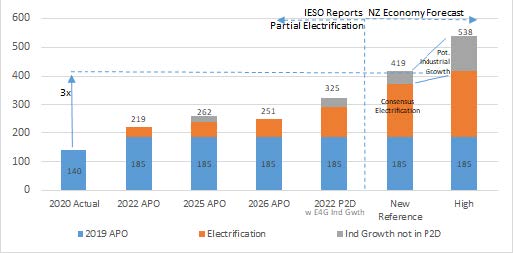
Examining the underlying assumptions embedded in the IESO’s APOs and P2D forecasts of demand to 2050 shows greater alignment of the electrification implications between the IESO’s assumptions and the New Reference, as illustrated in Figure 7. The most recent 2026 APO also provided an illustrative high case to capture some contingencies, as requested by the government.[37] It is this High case that the Ontario government references in support of the National Energy Corridor Agreement.[38] The IESO has further suggested next year’s 2027 APO might include additional partial industry and hydrogen electrification assumptions.[39] There is no indication as to when the IESO may consider electrification of building heating in its forecasts. Adding these additional partial industry and hydrogen electrification assumptions to the P2D forecast, which does include building heating, yields total new demand that is beginning to approximate the New Reference for a Net Zero (NZ) economy illustrated in Figure 7.
But it remains that the IESO’s current procurement planning activities and statements of system supply adequacy rely in the 2026 APO reference demand case. The APO reference case only captures 25 per cent of the Consensus Opinion on electrification and other growth factors.
The low growth forecast of the Annual Planning Outlook assumes much electrification will occur beyond a 25-year horizon — including full EV adoption and most electrification of industry, Heavy Duty (HD) transport, and building heating. The IESO has adopted a conservative approach to demand forecasting in order to minimize the risks of overbuilding. However, with substantial potential demand growth from electrification and industrial/economic expansion, focal points of both provincial and federal government policies, the question of what under-building risks these choices might present to Ontario’s supply adequacy as the economy evolves over the next 25 years becomes ripe for consideration.
Figure 7: Comparative 2050 energy demand forecast drivers[40]
(TWh, 2026 APO vs P2D vs new reference)

5.2 Supply shortfalls are emerging and putting Government ambitions at risk despite its initiatives
Ontario’s overarching economic development plan, outlined in the 2026 Ontario Budget: A Plan to Protect Ontario, focuses on building a competitive, resilient and self-reliant G7 economy.[41] It lays out several core initiatives including automotive and EV expansion and critical minerals. These are long term objectives. The Ontario Budget reflects the Energy for Generations plan and was released concurrently with the National Energy Corridor Agreement initiated by the Ontario Government.
In contrast, analysis of APO assumptions reveals a focus on near-term economic growth, with limited industrial growth assumed beyond 2030. While the 2026 APO’s expectation of a 65 per cent increase in demand reflects increased electricity demand for data centres,[42] the IESO has reduced the 2025 APO’s economic development provisions for most other areas, such as the auto sector.
The Ontario Government’s recent strategy statements assume the 90 per cent growth implied by the 2026 APO High demand scenario. Yet the IESO is not using this APO High demand scenario for resource planning purposes, and, furthermore, the High demand scenario does not include any provisions for critical minerals/Ring-of-Fire development, higher population growth that would accompany Ontario becoming the G7’s fastest growing economy, or the proposed high-speed rail to Montreal.[43]
Ontario has unveiled a bold nuclear development program
Notably, independent of the IESO, the Ontario government has created a plan and is moving ahead with a long-term nuclear program. Ontario currently has three nuclear sites, with two operated by Ontario Power Generation (OPG) and one operated by Bruce Power, with many current and future initiatives being pursued as summarized in Table 1. The Energy for Generations plan supports Small Modular Reactors (SMRs), Pickering refurbishment, Bruce C and Wesleyville, largely predicated on the 17 GW of new nuclear identified by the 2022 P2D. The government is also sponsoring the evaluation of OPG’s Nanticoke and Lambton sites for further nuclear opportunities.
Yet these planned resources are not enough. As the New Reference demand forecasts begin to emerge, it will become increasingly evident that extended development timelines will result in electricity supply shortfalls. Figure 8 illustrates a timeline of possible demand growth and the identified nuclear generation capacity initiatives from Table 1 (shown in green). The reddish line is the IESO 2026 APO reference case for baseload. The top of the grey is the 2026 APO high case demand for baseload. The blue dashed line is the New Reference demand, reflecting near term industrial demand from the 2025 APO and electrification growth straight-lined from the 2025 APO demand for 2035. The dotted light grey line is the total derated capacity at peak that may be needed, reflecting the need for flexible supply.
Table 1: Nuclear initiatives identified in Energy for Generations plan[44]
|
Facility |
Operator/location |
Initiative |
Description/capacity |
Status & timeline |
|
Darlington Nuclear Generating Station |
OPG Clarington |
Darlington refurbishment |
Refurbishment of 4 large CANDU reactors – 3,500 MW |
Completed, to extend station operation to the end of 2055. |
|
Bruce Nuclear Generating Station |
Bruce Power Kincardine |
Bruce refurbishment |
Refurbishment of 6 large CANDU reactors (Units 3-8) – 7,000 MW |
Ongoing to complete by 2033; ensures generation into the 2060s. |
|
Pickering Nuclear Generating Station |
OPG Pickering |
Pickering refurbishment |
Refurbishment of 4 CANDU reactors – 2,200 MW |
Planning phase underway to extend operating life by 30 years. |
|
Darlington New Nuclear Project |
OPG Clarington |
Darlington SMR Project |
G7’s first grid-connected Small Modular Reactor (GE Vernova Hitachi BWRX-300). Government directive includes 3 additional unites – 1,200 MW |
Construction underway. First SMR to be fully constructed by 2030. Total Darlington SMR capacity to be 1,200 MW |
|
Bruce Nuclear Generating Station |
Bruce Power Kincardine |
Bruce C (new build) |
New large-scale nuclear reactor build – up to 4,800 MW |
Federal Impact Assessment in progress. First new large-scale nuclear build in Ontario since 1993. |
|
Wesleyville |
OPG Port Hope/Clarington |
New nuclear |
OPG assessing new large-scale reactors – up to 10,000 MW |
Planning phase for impact assessment |
|
Nanticoke |
OPG Nanticoke |
New nuclear |
TBD |
Under consideration |
|
Lambton |
OPG Sarnia |
New nuclear |
TBD |
Under consideration |
The New Reference baseload demand shows how it may exceed APO planning by material amounts, not only in a long-term electrified economy, but also for industrial growth within the next 10 years.
Projected long-term demand for baseload supplies could be 15 to 20 GW beyond identified additional nuclear capacity. Furthermore, the timelines of advancing nuclear development leave under-supply risks in the medium-term that will be difficult to address and could be sustained for many decades. The grey shows how much baseload capacity to meet the 2026 APO high case demand would likely be needed to come from baseload natural gas-fired generation, potentially with mix of renewables and storage. The gap between the grey and the dashed blue line is the additional natural-gas-fired generation that may be needed to address the New Reference demand.
Figure 8: Potential capacity need vs APO baseload & nuclear plan[45]
(Demand and supply scenarios – GW of nuclear equivalent above hydro)

The gap between near-term baseload demand and the identified new nuclear capacity initiatives is large, and the long-term gap is larger, reflecting multiples of today’s grid capacity. With all of Ontario’s non-nuclear and hydro generation capacity set to contractually expire in the 2030s, Ontario could need to source an additional 14 GW of baseload supply for 2038 as well as 19 GW of flexible supply or 60 per cent of the needed total system supply capacity in the next decade.
Conservatively low demand forecast of the APO presents risks to policy makers
A. Mitigating demand growth may not be desired or possible
The identified supply shortfall risks reflect an assumed pace of demand growth. The government of Ontario may be unwilling to abandon its near-term Energy for Generations economic objectives, as it favours the more aggressive economic growth. In contrast, discouraging electrification in the medium- to long-term could mitigate some supply shortfalls, as the APO assumes — but could create political risks around Ontarians’ sentiment on global climate imperatives. Furthermore, demand arising from electrification may increase regardless of policy, as innovation-induced organic electrification adoption may advance even without policy — as EV and heat pump innovations accelerate globally. The war in Iran is also widely referred to as a tipping point in the global clean energy transition, impacting innovation adoption for energy security reasons.[46]
B. The nuclear program could get challenged
Figure 8 illustrates that the Energy for Generations nuclear initiatives exceed the 2026 APO baseload demand. If the 2026 APO reference case is to be relied upon as the formal basis for planning, then the Government’s nuclear program could be viewed as being too aggressive — by almost 5 GW in 2050 (e.g. Bruce C or part of Wesleyville would not be needed) and the nuclear program could be challenged.
C. More natural gas, and its emissions, may be inevitable
The gap between demand and confirmed supply presented in Figure 8 illustrates how demand growth could arrive before planned new nuclear or hydro electric capacity could be built, resulting in a substantial increase in Ontario’s gas-fired generating fleet over the next 10–15 years. Assuming ongoing demand growth from electrification, Ontario will then likely rely on energy from new natural gas-fired generating supply for decades as demand continues to outpace the availability of comparable electricity supply. The associated growth in emissions may create additional political risk.
5.3 Contingency plans are needed to address time-sensitive development challenges
Relying solely on the APO reference case for new generation procurement is creating significant development risk given the potential magnitude of the need for additional electricity supply, the lengthy development timelines involved, and the limited supply options available. The 2026 APO offers no contingency plans to address even the additional 2-3 GW of baseload that would be necessary to meet the APO high case demand for 2035, let alone the New Reference demand which is the recommended planning scenario presented in this article.
Contingency planning is warranted to identify how higher demand might be addressed, for both baseload supplies and flexible supply solutions whose output can match hourly, daily, weekly, and seasonal variations in demand.
The infrastructure development challenge is a doubling of all planned supplies
The baseload supply capacity in 2035 is 10 GW short of the needs to meet the Energy for Generations economic development objective, as illustrated in Figure 9. This gap of unserved baseload grows to 14 GW by 2050, and could potentially grow to 19 GW under the high demand scenario. Post 2050, this gap could be 33 GW beyond the currently contemplated 21 GW nuclear and hydro programs.
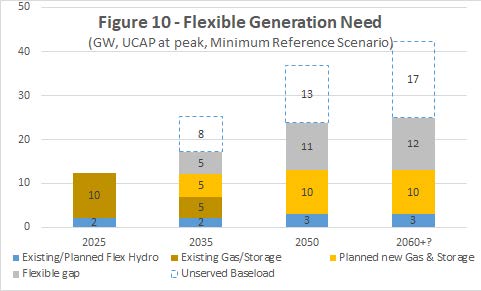
As set out in Figure 10, ensuring adequate flexible supply is equally challenging, with a projected 5 GW shortfall by 2035. If flexible supplies must address unserved baseload, the 2035 flexible supply shortfall could be 13 GW, an amount not currently reflected in the IESO’s procurement strategy. Even if long-term baseload supply is satisfactorily addressed, Ontario could need an additional 12 GW of flexible supply over that which the APO contemplates.
Figure 9: Baseload capacity needs[47]
(GW nuclear equivalent capacity)
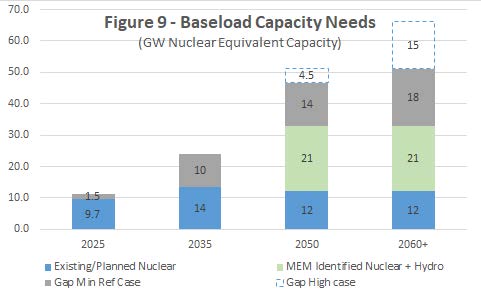
Figure 10: Flexible generation needs[48]
(GW, UCAP at peak, minimum reference scenario)
Building natural gas is no longer the easy path to choose
Relying on natural gas as the fuel of choice to mitigate short-term reliability risks may be at an end:
a) Canada’s Clean Electricity Regulation (CER) prohibits the significant operation of new unabated natural gas fired-generation post 2035. The recent federal national electricity strategy suggests that the CER will retain the long-term goal of a net-zero grid by 2050, but be modified to introduce more compliance flexibility to prevent stranded assets and ensure grid reliability. However, important details are not yet clear for new generation that will need to come into operation in the late 2030s and 2040s. Despite this, until the details are resolved for all provinces, the CER’s implied operational risks may inhibit new investments in natural gas-fired generation. Ontario may not have cost effective flexible generation solutions — even with significant rollouts of renewables and carbon capture, which are also currently unplanned. Furthermore, while not endorsing the CER, the IESO stated that the 2025 APO provides a pathway to a zero emissions grid by 2050.[49] However, under the identified New Reference demand growth neither the CER nor the IESO 2025 APO procurement approaches provide viable pathways to a net zero grid by 2050.[50]
b) Emerging supply chain bottlenecks may handcuff Energy for Generations ambitions. The world has recognized the implications of significant electricity demand growth, including the presence of non-traditional players, such as AI data centers, who are competing to build gas-fired generation.[51] The U.S. is embracing the need for significant new generation. Commercial interests are securing turbine supplier contracts but are facing 5-7 year wait times.[52] Despite turbine vendors investing in manufacturing capacity upgrades, order backlogs remain extended and some costs could triple.[53]
c) The ability to otherwise mitigate Ontario’s 2035 need for flexible capacity is low. New renewables and storage may sporadically reduce emissions but cannot materially reduce needed gas-fired generation capacity. Even 24-hour storage only modestly reduces gas capacity needs.[54]
d) Turbine supply chain constraints will spill onto nuclear projects. While different in design, steam turbines for nuclear are manufactured by the same global supply chains: Siemens, Mitsubishi, GE Vernova, and Hitachi. Many countries are advancing nuclear plans — for example, the U.S. has announced US$80 Billion of investments for new Westinghouse reactors and almost $18 Billion to build up the US nuclear supply chain.[55]
Contingency planning will highlight the risk implications for policy makers
Sustaining the IESO’s inclination towards conservative demand forecasts will likely defer decisions on new projects and technology choices, pushing Ontario farther behind in the supply chain order book, increasing future costs, and undermining the ability to secure the electricity supply options needed to sustain or achieve the province’s growth objectives. Possible higher demand scenarios should be transparently developed and matched with possible supply solution scenarios with clear depiction of schedule risks and cost implications.
6. Closing – Implications for Canada’s national electricity strategy
The drivers of electricity demand in Canada, from electrification to reduce emissions and from policy maker economic growth ambitions, are evident and emerging quickly. Yet the full implications of this significant demand growth are not being reflected in federal or provincial electricity system planning and initiatives. This is creating supply shortfall risks across this country as development awaits policy direction. The deferment of policy direction is delaying planning and procurement decisions beyond the timelines necessary to develop the infrastructure needed to meet anticipated demand. These risks have been illustrated through the case study on Ontario, the implications of which extend to most provinces in Canada. Quebec may stand out as an example of policies that are facing these challenges head on, reducing their risks, and may provide lessons to others.
The world is recognizing that countries with affordable reliable clean electricity will attract investment and win the economic development race.[56] Timely electricity system development is essential to the availability of the affordable and reliable electricity essential to powering Canada’s economic growth. In an increasingly clean energy world, affordable and reliable clean electricity will define the country’s international competitiveness.
6.1 A call to action for informed demand forecasting
To respond to these challenges, both provincial and federal governments must understand demand and supply risks to develop policies around strategic procurement alternatives and move Canadian provinces closer to the front of global supply chain queues. Given current policy makers’ economic priorities, the electricity system should be planned to get ahead of demand and enable economic growth. For this, the greater demand potential such as illustrated by the New Reference and High demand scenarios identified in this article must be clearly and appropriately put forward. Overlapping federal and provincial roles in such areas as nuclear strategies and national electricity corridor agreements would benefit from policy alignment.
The lack of alignment between provincial planning and electrification and economic development objectives must be resolved. The question comes down to timing: Should electricity system planners be building the infrastructure to accommodate demand before or after it arrives? The electricity system should be used as an enabler of economic growth, not a cautionary response to events that unfold. For electricity to be an enabler, infrastructure development must accelerate to get ahead of demand and do so promptly to ensure favourable positions in supply chain order books. It is clear that the electricity system cannot grow fast enough to meet anticipated increases in electricity demand arising from electrification and industrial/economic growth aspirations. As a result, there is merit to aggressively pursuing reliable and affordable solutions now. Alternatively, conservative electricity supply planning will lead to future urgent needs to secure supply that can be built quickly, like natural gas-fired generation — which, even if possible, will come with cost, environmental, and public opinion consequences.
In order to stay ahead of demand, both federal and provincial policy makers need validated risk-informed demand scenarios with associated resource portfolio alternatives. A consensus around these forecasts will help identify procurement strategies to align federal roles in a national electricity strategy with provincial electricity system development priorities. A well communicated consensus will send the signals to developers and markets that will enable them to propose the medium- and long-term solutions that are needed. Such a consensus will thus enable the urgent policy decisions to accelerate site selections, project identification and investment strategies to secure Canada’s energy future.
-
* Marc Brouillette is the principal consultant and founder of Strategic Policy Economics. Marc holds a BASc in System Design Engineering from the University of Waterloo and an honours MBA from the Schulich School of Business.
1 Natural Resources Canada, Powering Canada Strong: A National Strategy for an Electrified Canadian Economy (May 2026), online: <natural-resources.canada.ca/energy-sources/electricity-infrastructure/powering-canada-strong-national-strategy-electrified-canadian-economy>.
-
2 Ontario, Ministry of Energy and Mines, News Release, “Ontario Secures Groundbreaking National Energy Corridor Agreement” (4 March 2026), online: Ontario Newsroom <news.ontario.ca/en/release/1007115/ontario-secures-groundbreaking-national-energy-corridor-agreement>.
-
3 Supra note 1.
-
4 Ibid.
-
5 Ibid.
-
6 Colin Anderson, “Ontario’s economic future hinges on energy investment”, iPolitics (17 March 2026), online: <ipolitics.ca/2026/03/17/ontarios-economic-future-hinges-on-energy-investment>.
-
7 Ontario, Ministry of Energy and Mines, Energy for Generations: Ontario’s Integrated Plan to Power the Strongest Economy in the G7 (Toronto: King’s Printer for Ontario, 2025) at 4, online (pdf): <ontario.ca/files/2025-07/mem-energy-for-generations-en-2025-07-18.pdf>.
-
8 Supra note 2.
-
9 Ibid.
-
10 Supra note 1 [emphasis in original].
-
11 Strategic Policy Economics, Outlook for Nuclear Energy in Canada 2025 (Ottawa: Canadian Nuclear Association, 16 September 2025), online: <cna.ca/publication/outlook-for-nuclear-energy-in-canada-2025/outlook-for-nuclear-energy-in-canada-report-september-16>.
-
12 Alessia Simona Maratta, “Canada’s power grid is under pressure amid rising demand, watchdog warns”, Global News (7 February 2026), online: <globalnews.ca/news/11657048/canada-power-grid-under-pressure-rising-demand-watchdog-warns>; Robert Walton, “NERC forecasts peak demand to rise 24% on new data center loads”, Utility Dive (30 January 2026), online: <utilitydive.com/news/nerc-10-year-peak-demand-forecast-jumps-24-on-new-data-center-loads/810955>.
-
13 See Meris Lutz, “Utilities’ spending spree continues, according to their Q4 2025 reports”, Utility Dive (4 March 2026), online: <utilitydive.com/news/q4-2025-earnings-roundup-utilities-tout-load-growth/813742>; see also Brandon Owens & Morgan Bazilian, “As data centers go off-grid, utilities face new cost and planning risks”, Utility Dive (17 March 2026), online: <utilitydive.com/news/as-data-centers-go-off-grid-utilities-face-new-cost-and-planning-risks/811944>.
-
14 See Chris Bonasia, “Cold Snap Exposed Limits of Quebec-New England Power Deal”, The Energy Mix (11 February 2026), online: <theenergymix.com/cold-snap-exposed-limits-of-quebec-new-england-power-deal>; Tristin Hopper, “FIRST READING: How Canada squandered its most valuable national asset”, National Post (9 February 2026), online: <ca.news.yahoo.com/first-reading-canada-squandered-most-123725662.html>; Nelson Bennett, “Why B.C. is rewriting energy rules to decide who gets power and who doesn’t”, Business in Vancouver (21 November 2025), online: <www.biv.com/news/resources-agriculture/why-bc-is-rewriting-energy-rules-to-decide-who-gets-power-and-who-doesnt-11508107>.
-
15 Environment and Climate Change Canada, “Executive Summary of the Report: Greenhouse Gas Sources and Sinks in Canada: 2026” (14 April 2026), online: <canada.ca/en/environment-climate-change/services/climate-change/greenhouse-gas-emissions/sources-sinks-executive-summary-2026.html>.
-
16 Toward a National Energy Vision: Canada’s Low-Carbon Energy Infrastructure Opportunity in a Global Net Zero Future, CCRE Commentary 2021, M. Brouillette; Strapolec Analysis; Marc Brouillette, Toward a National Energy Vision: Canada’s Low-Carbon Energy Infrastructure Opportunity in a Global Net Zero Future, CCRE Commentary (Toronto: Council for Clean & Reliable Energy, December 2021), online: <thinkingenergy.ca/commentaries/ccre-commentary-toward-a-national-energy-vision-canadas-low-carbon-energy-infrastructure-opportunity-in-a-global-net-zero-future>.
-
17 International Energy Agency, Direct Air Capture 2022: A key technology for net zero (Paris: IEA, 2022), online: <iea.org/reports/direct-air-capture-2022>.
-
18 Marc Brouillette, Toward a National Energy Vision: Canada’s Low-Carbon Energy Infrastructure Opportunity in a Global Net Zero Future, CCRE Commentary (Council for Clean & Reliable Energy, 2021), online: <thinkingenergy.ca>. See Green Ribbon Panel, Clean Air, Climate Change and Practical, Innovative Solutions: Policy Enabled Competitive Advantages Tuned for Growth (2020), online: <greenribbonpanel.com/reports-and-publications>.
-
19 The largest emissions sources in Canada are in buildings, transportation and industry: see Canadian Institute for Climate Choices, Canada’s Net Zero Future: Finding our way in the global transition (2021), online: <climateinstitute.ca/reports/canadas-net-zero-future>.
-
20 See Algoma Steel, News Release, “Government of Canada Endorses Algoma Steel’s Transformation Plan for Green Steel: Commitment of up to $420 Million” (5 July 2021), online: <algoma.com/news/government-of-canada-endorses-algoma-steels-transformation-plan-for-green-steel-commitment-of-up-to-420-million>; ArcelorMittal, News Release, “ArcelorMittal and the Government of Canada announce investment of CAD$1.765 billion in decarbonisation technologies in Canada” (30 July 2021), online: <corporate.arcelormittal.com/media/news/regulatory-news/arcelormittal-and-the-government-of-canada-announce-investment-of-cad-1765-billion-in-decarbonisation-technologies-in-canada>; S Julio Friedmann, Zhiyuan Fan & Ke Tang, Low-Carbon Heat Solutions for Heavy Industry: Sources, Options, and Costs Today (New York: Center on Global Energy Policy, Columbia University, 2019), online: <energypolicy.columbia.edu/publications/low-carbon-heat-solutions-heavy-industry-sources-options-and-costs-today>.
-
21 Independent Electricity System Operator, Ontario Planning Outlook: A Technical Report on the Electricity System Prepared by the IESO (Toronto: IESO, 1 September 2016), online (pdf): <www.rds.oeb.ca/CMWebDrawer/Record/544592/File/document>; Council of the Great Lakes Region, Ontario’s Long-Term Energy Plan: Understanding Carbon Emissions, the Role of Nuclear, and Electricity Trade with Quebec (December 2016), online (pdf): <councilgreatlakesregion.org/wp-content/uploads/2016/12/Ontarios-long-term-energy-plan.pdf>.
-
22 Environment and Climate Change Canada, News Release, “Accelerating Canada’s clean power advantage” (9 November 2025), online: <canada.ca/en/environment-climate-change/news/2025/11/accelerating-canadas-clean-power-advantage.html>; Natural Resources Canada, Powering Canada’s Future: A Clean Electricity Strategy (2024), online: <natural-resources.canada.ca/energy-sources/powering-canada-s-future-clean-electricity-strategy>.
-
23 Canada Electricity Advisory Council, Powering Canada: A Blueprint for Success: Final Report (Ottawa: Natural Resources Canada, May 2024), online (pdf): <natural-resources.canada.ca/sites/nrcan/files/energy/electricity/Canada-Electricity-Advisory-Council-Final-Report-2024.pdf>.
-
24 Supra note 11.
-
25 Green Ribbon Panel, Submission for the Ministry of Energy, Northern Development and Mines Review of Ontario’s Long-Term Energy Planning Framework (27 April 2021), online (pdf): <ero.ontario.ca/public/public_uploads/2021-04/Green%20Ribbon%20Panel%20Submission.pdf>; Marc Brouillette, Toward a National Energy Vision: Case Study: Electricity System Implications for Ontario and Quebec, CCRE Commentary (Council for Clean & Reliable Energy, 30 June 2022), online: <thinkingenergy.ca/commentaries/toward-a-national-energy-vision-case-study-electricity-system-implications-for-ontario-and-quebec>.
-
26 Canada Energy Regulator, Canada’s Energy Future 2026: Energy Supply and Demand Projections to 2050 (Calgary: Canada Energy Regulator, 2026), DOI: <10.35002/57gd-q723>.
-
27 Canada, Department of Finance, Budget 2025: Canada Strong — Our Plan: Building Canada Strong (4 November 2025), online: <budget.canada.ca/2025/report-rapport/intro-en.html>.
-
28 Demand in Figure 3 has been segregated into two main types: (1) Baseload demand that is present 24×7, 365 days/year and well suited to being supplied by baseload nuclear and hydro; (2) Variable demand that reflects demand variations on a daily, weekly and seasonal basis, as well as the need for peaking supplies and reserve capacity – this demand requires dispatchable/flexible supply solutions such as hydro, natural gas-fired generation or some aggregated solution formed from a combination of renewables, storage, hydro and gas, etc. Strategic Policy Economics, Outlook for Nuclear Energy in Canada 2025 (Ottawa: Canadian Nuclear Association, 16 September 2025), online: Canadian Nuclear Association; Strapolec Analysis.
-
29 The Transition Accelerator, Forecasting Canada’s Electricity Future: Demand Growth, Key Drivers, and Implications for Provincial Planning, by Dunsky Energy + Climate Advisors (November 2025), online (pdf): <transitionaccelerator.ca/wp-content/uploads/2025/11/Forecasting-Canadas-Electricity-Future-Report-Final-November-2025.pdf>.
-
30 The Transition Accelerator, Forecasting Canada’s Electricity Future: Demand Growth, Key Drivers, and Implications for Provincial Planning, by Dunsky Energy + Climate Advisors (November 2025), Figure 8: “Electricity Demand by Province, 2025–2050, system outlooks and pathway studies”.
-
31 Marc Brouillette, Electrification Pathways for Ontario to Reduce Emissions: Procuring Ontario’s Energy Future (Strategic Policy Economics, August 2021), online: <strapolec.ca/publications>.
-
32 Strategic Policy Economics, Outlook for Nuclear Energy in Canada 2025 (Canadian Nuclear Association, 16 September 2025); Strapolec Analysis.
-
33 Supra note 7 at 150.
-
34 Independent Electricity System Operator, 2026 Annual Planning Outlook (Toronto: IESO, March 2026), online (pdf): <ieso.ca/-/media/Files/IESO/Document-Library/planning-forecasts/apo/2026/2026-Annual-Planning-Outlook.pdf>.
-
35 Independent Electricity System Operator, Pathways to Decarbonization (Toronto: IESO, 15 December 2022), online (pdf): <ieso.ca/-/media/Files/IESO/Document-Library/gas-phase-out/Pathways-to-Decarbonization.pdf>.
-
36 The 2019 and 2022 APO series are extrapolated to 2050 using the compound annual growth rate over the terminal years of the respective IESO forecasts; the published IESO forecast horizons end in 2040 and 2043, respectively. APO values represent the IESO’s reference forecast used for system planning. The 2026 APO Reference Scenario incorporates known industrial and economic-development loads but forecasts lower overall demand growth than the 2025 APO (65% versus 75% through 2050). Energy for Generations presents both the IESO APO and P2D Pathways demand outlooks and incorporates broader economic-development considerations. Any extension or adjustment of these published forecasts, including estimates concerning the timing of full-economy electrification beyond 2050, constitutes Strategic Policy Economics (Strapolec Analysis). Independent Electricity System Operator, Annual Planning Outlooks (2019–2026) and Pathways to Decarbonization (15 December 2022); Ontario, Ministry of Energy and Mines, Energy for Generations: Ontario’s Integrated Plan to Power the Strongest Economy in the G7 (12 June 2025); Strategic Policy Economics (Strapolec Analysis).
-
37 Supra note 34.
-
38 Supra note 2.
-
39 Independent Electricity System Operator, Annual Planning Outlook (APO): 2026 Demand Forecasts & 2027 Demand Scenario (Toronto: IESO, 18 November 2025), online (pdf): <ieso.ca/-/media/Files/IESO/Document-Library/engage/apo/apo-20251118-presentation.pdf>.
-
40 Independent Electricity System Operator, 2025 Annual Planning Outlook (April 2025), 2026 Annual Planning Outlook (March 2026), and Pathways to Decarbonization (15 December 2022); Ontario, Ministry of Energy and Mines, Energy for Generations: Ontario’s Integrated Plan to Power the Strongest Economy in the G7 (12 June 2025); Strapolec Analysis.
-
41 Ontario, Ministry of Finance, 2026 Ontario Budget: A Plan to Protect Ontario (Toronto: King’s Printer for Ontario, 26 March 2026), online (pdf): <budget.ontario.ca/2026/pdf/2026-ontario-budget-en.pdf>.
-
42 MaRS Staff, “Sharing the Load: How Collaborative Data Centre Expansion Could Lead to a Better Grid” (10 March 2026), online: MaRS Discovery District <marsdd.com/research-and-insights/data-centres-sharing-the-load>.
-
43 The Globe and Mail, “Ontario Advances National Partnership and Energy Expansion Strategy” (22 April 2026), online: <theglobeandmail.com/business/adv/article-ontario-advances-national-partnership-and-energy-expansion-strategy>.
-
44 Ontario, Ministry of Energy and Mines, Energy for Generations: Ontario’s Integrated Plan to Power the Strongest Economy in the G7 (Toronto: King’s Printer for Ontario, 12 June 2025), online: <ontario.ca/page/energy-generations> ; Strapolec Analysis.
-
45 IESO data from the 2025 Annual Planning Outlook (April 2025) and 2026 Annual Planning Outlook (March 2026); Ontario, Ministry of Energy and Mines, Energy for Generations (12 June 2025); Strapolec Analysis.
-
46 Kathryn Krawczyk, “The Iran war sparked a shift toward clean energy. Will it last?”, Canary Media (18 June 2026), online: <canarymedia.com/articles/clean-energy/iran-war-clean-energy>.
-
47 Figure 9 reflects nuclear equivalent name plate capacity; Illustrated existing Gas/Storage in 2025 includes all other resources; Independent Electricity System Operator, 2025 Annual Planning Outlook: Capacity Expansion Scenario, Costs, and Emissions (April 2025); Strapolec Analysis.
-
48 Figure 10 represents UCAP, derated capacity available at peak demand times; ibid.
-
49 Independent Electricity System Operator, 2025 Annual Planning Outlook (Toronto: IESO, April 2025), online (pdf): <ieso.ca/-/media/Files/IESO/Document-Library/planning-forecasts/apo/2025/2025-Annual-Planning-Outlook.pdf>.
-
50 Marc Brouillette, Patchworking Canada’s Energy Transition: Accelerating through Evidence-based Decision Making (backgrounder presented at the CCRE Energy Leaders Roundtable, Orangeville, Ontario, 26 October 2023), online (pdf): <thinkingenergy.ca/wp-content/uploads/2023/10/Patchworking-Canadas-Energy-Transition-Marc-Brouillette-Strategic-Policy-Economics-October-26-2023.pdf>.
-
51 Daniel Raimi et al, Global Energy Outlook 2026: How the World Lost the Goal of 1.5°C (Washington, DC: Resources for the Future, 7 April 2026), online: <rff.org/publications/reports/global-energy-outlook-2026>.
-
52 Gavin Maguire, “US-driven gas turbine crunch may speed global clean power uptake”, Reuters (3 February 2026), online: <reuters.com/markets/commodities/us-driven-gas-turbine-crunch-may-speed-global-clean-power-uptake-2026-02-03>; Bobby Noble, “5-year waits and rising costs: How demand is redefining the gas turbine market”, Utility Dive (23 March 2026), online: <utilitydive.com/news/5-year-waits-and-rising-costs-how-demand-is-redefining-the-gas-turbine-mar/813385>; Jared Anderson, “US gas-fired turbine wait times as much as seven years; costs up sharply”, S&P Global Commodity Insights (20 May 2025), online: <spglobal.com/energy/en/news-research/latest-news/electric-power/052025-us-gas-fired-turbine-wait-times-as-much-as-seven-years-costs-up-sharply>.
-
53 Wood Mackenzie, Press Release, “Gas Turbine Prices Soar 195% as Market Faces Supply-Demand Crisis” (1 April 2026), online: <woodmac.com/press-releases/gas-turbine-prices-soar-195-as-market-faces-supply-demand-crisis>.
-
54 Supra note 50.
-
55 Mark Shenk, “Westinghouse Megadeal Set to Revitalize Nuclear Supply Chain”, Reuters (26 January 2026), online: <reuters.com/business/energy/westinghouse-megadeal-set-revitalize-nuclear-supply-chain–reeii-2026-01-26>; “US Federal Loan to Jumpstart AP1000 Reactor Supply Chain”, World Nuclear News (24 June 2026), online: <world-nuclear-news.org/articles/us-federal-loan-to-jumpstart-ap1000-reactor-supply-chain>.
-
56 Kamen Kraev, “Access To Electricity Will Determine Economic Success Or Failure, Says Magwood”, NucNet (20 March 2026), online: <www.nucnet.org/news/access-to-electricity-will-determine-economic-success-or-failure-says-magwood-3-5-2026>.