
INTRODUCTION
Canada’s electricity grid is vast, complex, and quietly impressive. From Labrador to Vancouver Island, most Canadians live within reach of reliable power. Yet beneath that apparent unity lies a striking fragmentation: ten provinces, ten regulators, and ten distinct sets of rules. Electricity flows freely north and south into the United States — but rarely east and west across Canada itself.
As Canada increasingly electrifies, while at the same time decarbonizes electricity generation and tightens economic integration, this patchwork raises an urgent question: can Canada build a truly national grid — one that serves all Canadians with affordable, reliable, and clean power? The answer may depend less on erecting copper wires and steel towers than on something harder: building cooperation.
Historically, Canada’s power system evolved as a collection of provincial networks, most with more ties to its southern neighbour than to each other. Manitoba sells power to Minnesota; Quebec to New York; British Columbia to Washington. Transmission corridors north-south rather than east-west.
This pattern made sense at first. Geography made east–west links expensive — the Canadian Shield and the Rockies are unforgiving terrain — and the biggest nearby customers were in the U.S. But it has left the country with a structural blind spot: interprovincial trade is the exception, not the norm. Like wine and beer, much less electricity flows across provincial boundaries than across our international border with the United States.
Now, as climate policy drives electrification with intermittent renewable energy increasingly reshaping supply, and an awakened interest in internal trade and concerns about energy security, there’s renewed enthusiasm for strengthening east–west connections. The logic is sound. Provinces could share electricity the way they already share pipelines and railways — balancing peaks and valleys in demand and smoothing the intermittency of wind and solar power. But steel and copper alone won’t fix the system — Canada also needs regulatory institutions that make those wires work in the public interest.
The trouble is that Canada needs effective governance structures for a national grid. We have no equivalent to the United States’ Federal Energy Regulatory Commission (“FERC”), which coordinates interstate markets and enforces open-access rules. Nor do we have a national transmission operator or reliability coordinator. Instead, our electricity system functions as a set of interconnected regional islands — linked physically, separated institutionally.
This fragmentation shows up perhaps most clearly at the seams: the interties connecting provinces. These lines could be Canada’s greatest reliability asset, allowing clean energy to flow where it’s needed and reducing the need for redundant capacity. Yet too often, they sit underused. Alberta’s 2025 intertie restrictions offer a case study in how technical caution, economic issues and policy gaps can converge to limit interprovincial cooperation.
The Alberta episode also underscores a deeper problem: without harmonized rules or a coordinating authority, no one is truly responsible for optimizing Canada’s grid as a whole. Canada’s federal energy regulator, the CER, has limited jurisdiction; provincial regulators focus inward; market operators lack mandates beyond their borders. As a result, national reliability depends on a patchwork of bilateral arrangements, good faith, and luck.
The following sections traces how Alberta’s experience exposes those fault lines, how the AESO’s Restructured Energy Market reform process addressed them, and how lessons from the U.S. FERC could point toward a more coherent national model for Canada.
ALBERTA AND ITS INTERTIES – CANARY IN THE COAL MINE?
In September 2025, an early-autumn heatwave pushed provincial demand to near-record highs. As air conditioners and industrial loads spiked, the Alberta Electric System Operator (“AESO”)quietly derated every intertie — the transmission connections to British Columbia, Saskatchewan, and Montana — to zero imports. For several critical days, Alberta could neither draw power from its neighbours nor export any excess.[1]
Under normal conditions, Alberta’s interties are a significant reliability asset. The Alberta–B.C. connection, part of the Western Electricity Coordinating Council’s (“WECC”) Path 1, can carry roughly 1,200 megawatts west to east and 1,000 MW east to west. The 230-kilovolt Montana–Alberta Tie Line (“MATL”) adds about 300 MW, while two smaller links to Saskatchewan supply roughly 150 MW combined. Yet during that week, all of them sat idle.
According to a recent Business in Vancouver article, this is not the first time, at least for the
BC-Alberta intertie: the Alberta-bound line has rarely reached its eastward capacity overthe past two decades.
Records show Alberta has consistently limited transmission to between 40 and 60 per cent of what can be delivered, even though B.C. allowed in over 90 per cent of the intertie’s rated capacity.[2]
Similar deratings have also long been occurring on the MATL as alleged in an October 2024 letter from the American Clean Power Association and American Council on Renewable Energy to Ambassador Katherine Tai the U.S. Trade Representative to Canada.[3]
This is illustrated in the chart below (ATC = Average Transfer Capability, TTC = Total Transfer Capability).[4]
Average annual path rating by transfer path
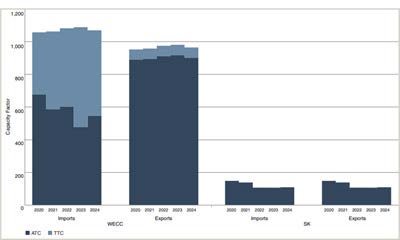
The AESO cites reliability as the reason for the deratings — it considers that relying on the intertie for imports exposes the province to risk in the event of a sudden loss of the intertie. It also claims that operational limits on lines in Alberta connecting to some of the interties contribute to the need to derate the interties. Critics accused Alberta of using “reliability” as a pretext for economic protectionism — shielding local generators and driving up domestic prices.
The Alberta Chambers of Commerce estimated that such limitations had cost consumers between $300 million and $500 million over several years. Mark Zacharias of Clean Energy Canada put it more bluntly: “What you’re seeing are the symptoms of provincial energy fiefdoms.”
This example exposes a deeper issue: no institution in Canada has the authority or incentive to ensure interprovincial lines are used optimally for national reliability. The Canadian Energy Regulator oversees the physical approval of international and, theoretically, interprovincial lines, but it has no operational or tariff-setting powers once a line is built. Provincial regulators such as the Alberta Utilities Commission (“AUC”) and the BC Utilities Commission (“BCUC”) regulate within their own borders, with little obligation to harmonize with one another.
In this case it left the AESO, a provincial market operator, effectively making national reliability decisions by default. When it derates or restores its intertie capacity, the consequences ripple across the Western grid. Yet those decisions are made under provincial authority, guided by Alberta’s Electricity Act — not by a pan-Canadian framework.
UPGRADING THE BC-ALBERTA INTERTIE
In 2018, according to material on the AESO website, the “Alberta — British Columbia Intertie Restoration” kicked off, and in that year, there was a joint public consultation conducted by AESO and AltaLink, Alberta’s transmission owner. On the website, AESO stated that:
Alberta’s interconnection with British Columbia is not currently operating to, or near to, its path rating. To restore the intertie, the AESO has determined additional equipment in close proximity to the existing 500 kV transmission line, called transmission line 1201L, is required, along with clearance mitigation work on specific portions of the existing 1201L line and upgrades to the 500/240 kV transformation capacity at the existing Bennett substation, near Langdon.[5]
In a January 2018 Newsletter, also on the project website, the AESO stated that it planned to file a separate application with the AUC, in conjunction with AltaLink’s facilities application for this project, by mid-2019.[6] The latest update on the site, a letter dated January 18, 2022, states:
The AESO continues to evaluate and assess all available options for the restoration of the Alberta-British Columbia Intertie to its path rating. We anticipate these evaluations to take place over the next year, and we will communicate next steps with impacted stakeholders once we have completed this work.[7]
However, it turned out that the proposed work on the BC intertie would have to wait until at least 2026. Attention was shifting from transmission engineering to a revised wholesale market design to, in part, address a mismatch between the approach to managing wholesale market in Aberta as compared to its neighbours.
BC, Montana and Saskatchewan, the three connected jurisdictions have no competitive wholesale market. All three are “vertically integrated” jurisdictions. Individual utilities have a franchise territory where they own and operate generation, transmission and distribution facilities. Retail rates are set on a cost-of-service basis; and there is no economic regulation of wholesale rates or a transparent mechanism of price discovery for wholesale rates.
The AESO’s Market Pathways Report (2022) identified five structural barriers to efficient intertie use: (1) misaligned pricing intervals, (2) lack of congestion management mechanisms, (3) inconsistent treatment of import bids, (4) inadequate ancillary service procurement, and (5) limited reciprocity between vertically integrated and competitive markets.[8]
AESO concluded that these challenges could not be fixed through hardware alone — they required a restructured market framework.
THE AESO’S NEW RESTRUCTURED ENERGY MARKET (REM)
On July 18 2024, the Alberta Electric System Operator (AESO) released its Intertie Participation Options Paper to gather feedback on how Alberta’s transmission connections could operate within the Restructured Energy Market (REM).[9] AESO emphasized that intertie design was central to efficient and fair electricity exchange with neighbouring jurisdictions and outlined objectives of affordability, reliability, 2050 decarbonization, and reasonable implementation.
The paper presented four options:
1. Status Quo – self-scheduled trades remain price-takers;
2. Priced Interties – economic offers and bids;
3. Optimized Scheduling – coordinated dispatch between provinces; and
4. Joining Western Markets – participation in SPP Markets+ or CAISO EDAM.
Over 30 stakeholders participated, including Powerex, SaskPower, Berkshire Hathaway Energy Canada, TransAlta, and Capital Power. Powerex supported transparent, market-based participation but warned against unilateral import curtailments. Berkshire Hathaway argued that unclear access pricing deterred investment, while Alberta generators cautioned that more imports could suppress prices and reduce domestic investment.[10]
AESO’s Final Design stopped short of full external market integration (Option 4). Instead, it incorporated intertie participation rules directly into the REM framework — defining eligibility, scheduling, cost allocation, and operational constraints — to balance reliability, affordability, and emissions goals.
A ministerial directive (Dec 10 2024) required AESO to:[11]
- File a plan with the AUC by 2026 to restore and upgrade the AB-BC intertie;
- Maintain high levels of ancillary services for full import capability on both the AB-BC and MATL lines;
- Proceed without competitive procurement; and
- Collaborate with the AUC to implement five-minute settlement intervals by 2032 (system-wide by 2040).[12]
The REM process illustrates Canada’s paradox: energy-market innovation thrives provincially, yet without interprovincial coordination, reforms remain isolated experiments rather than components of a unified continental system.
LIMITED CANADIAN FEDERAL JURISDICTION OVER REGIONAL TRANSMISSION
When Canadians think of electricity, they think provincially: Hydro-Québec, BC Hydro, Manitoba Hydro, Ontario’s IESO, Alberta’s AESO. Ottawa is rarely part of that picture. The reason lies in the Constitution — and in decades of institutional inertia that have kept electricity regulation largely within provincial borders. Yet, as interdependence grows, the absence of federal coordination is becoming increasingly costly.
Under the Canadian Energy Regulator Act (CER Act), the Canadian Energy Regulator (“CER”) has clear authority over international and interprovincial power lines. Section 261 allows the federal Cabinet to designate a line as interprovincial, while Section 262 requires that designated lines obtain a federal certificate of public convenience and necessity.¹⁶ Section 58.1 empowers the CER to adopt and enforce reliability standards for designated lines and international connections, aligning Canada with the reliability framework of the North American Electric Reliability Corporation (“NERC”).
Yet despite this robust statutory language, the federal role in electricity transmission is narrow in practice. Since the National Energy Board Act was replaced by the CER Act in 2019, no interprovincial power line has ever been designated – and it appears that in its considerably longer history, the CER’s predecessor the National Energy Board didn’t either. The CER continues to regulate international lines and exports, but its oversight of interprovincial transmission remains largely theoretical.
This governance gap has significant consequences. When any province derates its interties, it affects system reliability across the interconnection. Yet there is no federal mechanism — short of political negotiation — to resolve such disputes. The CER cannot compel provinces to restore capacity or to harmonize tariffs. Nor can it enforce reciprocal treatment for intertie participants.
The irony is that Ottawa has stronger authority over cross-border lines with the United States than over lines connecting two Canadian provinces. This asymmetry reflects a federalism built for a different era — one in which provinces were self-contained systems with limited interdependence. Today, it is a structural weakness.
This institutional gap contrasts sharply with the situation in the United States, where the Federal Energy Regulatory Commission (FERC) operates as a powerful central referee.
Understanding that contrast helps illuminate what Canada lacks — and what a future cooperative model might require.
HOW DOES THIS COMPARE TO FEDERAL JURISDICTION IN THE U.S.?
If the Canadian Energy Regulator’s authority over interprovincial electricity is at the modest of a spectrum, the U.S. Federal Energy Regulatory Commission (“FERC”) stands at the opposite end, FERC is the keystone of a unified federal framework for electricity transmission, wholesale markets, and reliability. Its evolution shows how a federal system can balance state autonomy with national coordination — something Canada has yet to achieve.
FERC’s authority over the electricity transmission system in the US[13] comes from the Federal Power Act (“FPA”) of 1935, which extended federal jurisdiction to “the transmission of electric energy in interstate commerce” and to “the sale of such energy at wholesale in interstate commerce.”The rationale was simple: electricity flows do not respect state borders, and uncoordinated regulation risked creating balkanized systems. The U.S. Constitution’s Interstate Commerce Clause gave Congress the power to regulate such trade, allowing the federal government to impose consistent rules across states.
As a result, if wholesale electricity sales, even within a single state, can affect interstate flows and markets they fall under federal jurisdiction. Therefore, if a wholesale transaction occurs entirely within one state (both buyer and seller located in the same state), FERC can and does regulate it if:
- The electricity flows on an interconnected grid that crosses state lines (which most U.S. grids do), or
- The transaction effects interstate wholesale prices or reliability.
Today, FERC’s jurisdiction encompasses the transmission and wholesale sale of electricity in interstate commerce, along with natural gas pipelines and hydropower licensing. Its mission is to ensure that rates are “just and reasonable,” that markets operate without undue discrimination, and that reliability standards are maintained.
This authority is not absolute—states still control retail electricity rates, resource planning, and siting of generation—but it is extensive enough to unify the backbone of the U.S. grid. Any transaction or facility that affects interstate flows falls within FERC’s purview.
Orders 888 and 889: Opening the grid
Modern U.S. electricity markets may well have been born in 1996, when FERC issued Orders 888 and 889. Order 888 required vertically integrated utilities to provide open, non-discriminatory access to their transmission systems — a notion now embedded in Open Access Transmission Tariffs (“OATT”). Order 889 complemented this by creating the Open Access Same-Time Information System (“OASIS”) — a public database showing available transmission capacity in real time. For the first time, generators and traders could see and reserve capacity on a transparent, standardized platform. The combination of these orders laid the groundwork for competitive wholesale markets across much of the U.S.
Order 2000 and the rise of RTOs
In 2000, FERC issued Order 2000, encouraging utilities to form Regional Transmission Organizations (“RTOs”). These entities coordinate regional dispatch, transmission planning, and congestion management, effectively serving as neutral grid operators over multi-state territories. Today, RTOs along with similar single-state ISOs manage more than two-thirds of the U.S. electricity load.
The largest — the PJM Interconnection — spans 13 states and the District of Columbia, coordinating a market of over 1,000 participants. Others include the Midcontinent Independent System Operator (“MISCO”), the Southwest Power Pool (“SPP”), the California Independent System Operator (“CAISO”), the New York ISO (“NYISO”) and the ISO New England (“ISO-NE”). These organizations operate energy, capacity, and ancillary service markets under FERC-approved tariffs, ensuring transparent and consistent pricing across vast regions.
Orders 1000 and 2222: Planning for a changing grid
As the grid evolves, so does FERC’s regulatory toolkit. Order 1000 (2011) required regional and interregional transmission planning and cost allocation. It forced utilities and RTOs to coordinate investment in new lines that provide regional benefits, ensuring that costs are shared equitably.
More recently, Order 2222 (2020) opened wholesale markets to distributed energy resources (“DERs”) such as batteries, rooftop solar, and aggregated demand response. This order recognized that reliability and efficiency increasingly depend on the integration of small, flexible assets — a shift Canada is only beginning to grapple with.
FERC, electricity reliability and NERC
FERC delegates reliability oversight in the U.S. to NERC, which operates under FERC’s authority. Section 215 of the Federal Power Act, added in 2005, make NERC’s standards mandatory and enforceable.
Reliability standards include standards for physical and cyber-security, vegetation management, maintaining generation and load balance, emergency preparedness and operations, facilities ratings, reserve margin requirements, providing accurate data and models for planning and operations, transmission operations, transmission planning and connecting inverter-based resources to the grid.
NERC develops reliability standards through a stakeholder process; FERC approves them and enforces compliance through fines and corrective actions.
This arrangement—federal oversight with delegated technical implementation—ensures both accountability and flexibility. It also binds Canada to the same reliability framework, since Canadian utilities that trade with U.S. markets must comply with NERC standards.
THE RECIPROCITY PRINCIPLE
When FERC issued Order 888 in 1996, requiring open access to transmission networks, it also extended a condition of reciprocity to foreign utilities. To sell into U.S. wholesale markets, non-U.S. entities had to provide “comparable open access” at home. That meant Canadian utilities wishing to export electricity to the U.S. had to offer similar non-discriminatory access to their own transmission systems.
The result was subtle but profound. Without passing new legislation, Canada’s provinces effectively adopted FERC’s open-access framework through self-interest. Most large Canadian utilities — BC Hydro, Manitoba Hydro, Hydro-Québec, and IESO — developed Open Access Transmission Tariffs (“OATTs”) that mirrored FERC’s pro forma tariff, sometimes almost word-for-word.
In practice, this meant that a generator in Washington or Minnesota could access transmission on comparable terms to a generator in Alberta or Ontario. It also ensured that Canadian exports complied with FERC’s transparency requirements. Reciprocity, in short, became the mechanism through which U.S. federalism shaped Canadian electricity policy — without any formal treaty or constitutional amendment.
Reliability alignment
The Canadian Energy Regulator (“CER”) formally recognizes NERC and its regional entities — WECC, MRO, and NPCC (Northeast Power Coordinating Council) — as the basis for Canadian reliability compliance. Provinces with direct connections to the US portion of the grid adopt and enforce most or all NERC reliability standards and, in most cases, they are enforced by the province’s utility regulator.
This arrangement ensures that Canada and the U.S. operate under a single continental reliability framework. It also provides a degree of technical consistency that makes cross-border power trade seamless. However, the system relies entirely on voluntary adoption and self-enforcement. If a province chose not to apply NERC standards, no federal Canadian body could compel it to do so.
A voluntary web, not a national grid
Canada’s participation in NERC and adoption of FERC-style tariffs may give the illusion of continental integration. In reality, the system depends on voluntary compliance and bilateral goodwill. This structure works when provincial interests happen to align, but it lacks mechanisms for resolving disputes or balancing costs and benefits. When Alberta derates its interties, or when provinces disagree over wheeling charges, there is no referee to call a foul. The handshake holds only as long as both parties choose to clasp hands. As we saw in the Alberta example, Montana’s right to access Alberta intertie doesn’t trump Alberta’s reliability concerns and the operational decisions to derate the capacity of the intertie.
As Canada pursues increased electrification, this voluntary patchwork looks increasingly fragile. The federal government has begun to acknowledge this through programs like the Smart Renewables and Electrification Pathways Program (“SREPs”) and the Pan-Canadian Grid Council, but without clear regulatory authority, coordination remains aspirational.[14]
The next step, many analysts argue, is to evolve from a handshake to a framework — a cooperative model that preserves provincial autonomy while establishing enforceable rules for reliability and open access. The U.S. experience suggests that such a model is achievable within a federal system. Whether Canada can muster the political will to build it remains an open question.
RELIABILITY THROUGH DIVERSITY – WHY WE NEED A CANADIAN GRID
Although the ability to buy and sell electricity from and to a neighbouring province directly benefits both of those provinces, Interprovincial interties can benefit more than just the two provinces they connect. Broader east-west (and west-east) diversity can be a driver to electricity trade across the entire country. For example, the evening peak load in Manitoba occurs about two hours before the evening peak in BC. This can enable BC to supplement Manitoba’s generation to help meet demand and vice versa. Connecting provincial electricity grids east-west in Canada allows provinces to leverage this load diversity thereby reducing the need for new generation capacity in each province as population and load grows.
East-west transmission also provides for geographical diversity for intermittent renewables — if the wind isn’t blowing in New Brunswick, it may be blowing somewhere in Ontario or vice versa. It also enables provinces with dispatchable generation (such as hydroelectricity), to “firm up” intermittent generation sources in other provinces by providing electricity when those intermittent sources can’t produce electricity.
Economists have long shown that regional diversity reduces the total amount of capacity needed to maintain reliability. A 2022 study by the Canadian Climate Institute estimated that better interprovincial connectivity could cut total generation investment needs by up to $1.7 billion per year by 2050.[15] In other words, sharing reserves and balancing variability can save money while improving resilience.
A national reliability framework would also diversify risk. Extreme weather—floods in B.C., droughts on the Prairies, ice storms in Ontario—rarely respects borders. If one province experiences an outage or generation shortfall, access to neighbouring systems can prevent cascading failures. In a fully cooperative grid, no province would need to overbuild “just in case.”
Equity in access and price
Reliability and equity are two sides of the same coin. Provinces rich in dispatchable hydro capacity, such as B.C., Manitoba, and Québec, possess valuable flexibility that can firm intermittent renewables elsewhere. Provinces without such resources, such as Alberta and Saskatchewan, face higher costs to ensure adequacy. Coordinated trade could equalize those advantages — allowing hydro provinces to earn revenue from flexibility while fossil-reliant provinces access clean power at competitive prices.
Without coordination, however, disparities deepen. Electricity prices in Canada vary by a factor of three — from less than $0.08 per kWh in Manitoba to more than $0.25 in parts of Atlantic Canada. Some of that reflects resource endowment, but many stem from policy fragmentation. When provinces invest in redundant capacity rather than shared infrastructure, consumers pay for isolation.
Why equity matters
Increased electrification will amplify these challenges. Decarbonizing electricity is a national goal, but the cost and feasibility vary by province. Hydro-rich regions will decarbonize electricity relatively easily; fossil fuel-dependent ones will struggle unless they have access to less emissive energy. A fair transition therefore requires interprovincial cooperation—not charity, but reciprocity.
Equity also matters politically. Public support for national climate policy depends on visible fairness. If one province bears higher costs because it lacks local resources, resentment grows. A shared grid distributes both opportunity and responsibility. That is the essence of cooperative federalism: not uniformity, but mutual aid.
Reliability as a national asset
Electric reliability is often seen as a provincial metric — measured in SAIDI (System Average Interruption Duration Index) and SAIFI (System Average Interruption Frequency Index) scores. But at scale, it is a national asset. Reliable electricity underpins every modern industry, from manufacturing and mining to digital services. When reliability falters in one region, it affects supply chains, prices, and public confidence nationwide. And as we appear prepared to extend our dependence on electricity to the transportation sector, electricity reliability’s effect on us all will have an even greater impact.
In this sense, reliability is to the electricity sector what interprovincial highways are to transportation: a shared foundation for economic life. Yet while Canada has a national highway system funded by both orders of government, it has no equivalent for transmission. The infrastructure exists, but the governance does not.
CONCLUSION: BUILDING TRUST ALONGSIDE WIRES
The story of Canada’s electricity grid is, at its heart, a story about trust. Wires can carry power, but only institutions can carry confidence. The physical infrastructure of interties and substations is impressive, but without a framework of shared governance, it remains underused — a half-built national project.
Learning from FERC – without copying it
Canada need not replicate FERC, but it can learn from its approach. FERC’s authority rests not on centralization but on clarity: states know what they control (generation and retail), and the federal government knows what it controls (interstate transmission and wholesale markets). That clarity creates predictability, which attracts investment and enables planning.
Canada’s current ambiguity—Ottawa has theoretical jurisdiction over interprovincial lines but exercises none—creates the worst of both worlds: overlapping accountability with no enforcement. A clearly defined cooperative model, backed by federal recognition of interprovincial lines, would bring order to this uncertainty.
From policy to politics
The barriers to such reform are not technical; they are political. Provinces fear losing control, and the federal government fears provoking them. But history shows that shared jurisdiction need not mean zero-sum control. Confederation itself was built on the idea that common infrastructure could coexist with local autonomy. The Intercolonial Railway[16] of the 19th century was a federal project serving provincial economies. The Trans-Canada Highway and national pipelines followed the same logic. Electricity transmission should be no different.
The political calculus may also be changing. Extreme weather, supply-chain disruptions, and the rising cost of reliability have made energy security a mainstream public concern. Voters care less about jurisdictional pride than about keeping the lights on. As electricity becomes the backbone of the net-zero economy, its governance will inevitably become more national in character.
A model of cooperative federalism
FERC’s structure demonstrates that federal coordination need not undermine regional autonomy. States retain control over generation choices and retail markets, while FERC provides a transparent, rules-based framework for interstate reliability and commerce. The result is a system that encourages investment, facilitates renewables, and manages congestion across borders.
For Canada, this contrast is instructive. The U.S. model shows that even in a federal country with strong state rights, national reliability and open access can be achieved through legislation, delegation, and clear accountability. It offers not a blueprint for replication, but a useful example.
What Canada needs is not a top-down federal takeover but a federated reliability compact — a binding framework built on cooperation, transparency, and reciprocity. Provinces would retain operational control but commit to shared standards and dispute resolution mechanisms overseen by the CER or a similar organization.
This could begin modestly: joint planning for a handful of key interties and coordinated reserve-sharing agreements. Over time, it could evolve into a country-wide partnership, reflecting Canadian values of equity and regional balance.
The payoff would be enormous. A more interconnected grid would reduce costs, enhance reliability, and help to support electrification policy — all without sacrificing provincial autonomy. It would also allow Canada to present a coherent face to the United States in cross-border market integration, strengthening both sovereignty and competitiveness.
Building trust alongside wires
Ultimately, the challenge of interprovincial cooperation is less about electrons than about institutions. Trust, once built, can help move power fast, reliably and efficiently. But trust requires rules — clear, fair, and enforceable. Canada’s energy future will depend on whether it can move from handshake diplomacy to a rules-based partnership among provinces and between provinces and Ottawa.
The lesson from Alberta’s REM, from FERC’s evolution, and from the CER’s dormant authority is the same: cooperation is not an act of charity; it is an act of prudence. As the grid becomes the central nervous system of our economy, Canada must decide whether that system will be a collection of provincial reflexes or a coordinated national response.
Some wires already exist and the rest can be built. The question now is whether we have the will to connect them.
-
* David Morton, Interprovincial Cooperation and Energy Reliability, (Canadian Energy Reliability Council, 2025).
1 For the three interties, AESO data shows:
From September 1 to September 7 – between 400 MW and 600 MW.
From September 8 to September 18 – between 0 MW and 200 MW
From September 19 to September 28 – 0 MW
From September 29 to October 1 – between 400 MW and 600 MW.
-
2 Stefan Labbé, Failed B.C.-Alberta transmission line holds lessons for a national grid, (last modified 18 July 2025), online: <biv.com/news/resources-agriculture/failed-bc-alberta-transmission-line-holds-lessons-for-a-national-grid-10725383>.
-
3 United States Council for International Business, “Comments Regarding Foreign Trade Barriers to U.S. Exports for 2025 Reporting—Canada [Docket Number USTR-2024-0015]” (Washington, D.C.: 2024); American Clean Power Association, Press Release, 220508 “Joint Statement from American Clean Power Association and American Council on Renewable Energy to Ambassador Katherine Tai United States Trade Representative Office of the U.S. Trade Representative” (17 October 2024).
-
4 Albert Electric System Operator, 2024 Annual Market Statistics, (Alberta: 2025) at 29, online (pdf): <aeso.ca/assets/Uploads/market-and-system-reporting/Annual-Market-Stats-2024.pdf>.
-
5 Alberta Electricity System Operator, “Transmission Project: Alberta – British Columbia Intertie Restoration (7006)” (last visited 21 January 2026), online: <aeso.ca/grid/transmission-projects/intertie-restoration>.
-
6 Alberta Electricity System Operator, “Alberta – British Columbia Intertie Restoration” (January 2018), online (pdf): <aeso.ca/assets/Uploads/Tx-Newsletter-AB-BC-Intertie-Restoration-Final.pdf>.
-
7 Letter from Mike Deising, Director of Communications & Stakeholder Relations (31 January 2022) letter to update stakeholders on the status and timinf the Alberta-British Columbia Intertie Restoration project, online (pdf): <aeso.ca/assets/Uploads/projects/2022-Update-letter-Intertie_FINAL.pdf>.
-
8 Alberta Electric System Operator, Market Pathways Report (Calgary: Alberta Electric System Operator, 2022).
-
9 Alberta Electric System Operator, Restructured Energy Market (2024).
-
10 Alberta Electric System Operator, Request for Feedback on REM Intertie Participation Options: July 18 – Aug. 9, 2024 (last visited 21 January 2026), online: <aesoengage.aeso.ca/rem-intertie-participation/surveys/rem-intertie-options-initial-stakeholder-input>.
-
11 Letter from the Minister of Afordability and Utilities of Alberta, Nathan Neudrof, to the President and Chief Executif Officer of the Alberta Electirc System Operator (10 Decembre 2024), online (pdf): <ehq-production-canada.s3.ca-central-1.amazonaws.com/38a16e7be66e925f4b09f1d909e64f0a6c40d908/original/1733868706/b1377d0d48bd3f0f4b39963b4d7f993d_Direction_Letter_from_Minister_10Dec2024.pdf>. See also Jessica Kennedy et al., “Alberta Issues Directive for Power Regime Overhaul: Fast and Furious Implementation” (18 December 2024), online (blog): <bennettjones.com/Insights/Blogs/Alberta-Issues-Directive-for-Power-Regime-Overhaul-Fast-and-Furious-Implementation/pdf>.
-
12 The AESO also sought public comment on 5-minute settlement intervals as part of the REM consultation process.
-
13 The “interconnected grid” regulated by the FERC, includes all lines operating at 100 kV or greater and is referred to as the Bulk Electric System or BES.
-
14 Natural Resources Canada, Smart Renewables and Electrification Pathways Program (SREPs): Program Overview (Ottawa: Natural Resources Canada, 2023).
-
15 Canadian Climate Institute, Connected and Ready: How Interprovincial Transmission Can Help Canada Achieve Net Zero (Ottawa: Canadian Climate Institute, 2022).
-
16 As a historic Canadian railway that operated from 1872 to 1918, when it became part of Canadian National Railways. As the railway was also completely owned and controlled by the Government of Canada, the Intercolonial was also one of Canada’s first Crown corporations.