Comment on Ahmad Faruqui, “Real Time Pricing of Electricity for Households: An International Survey”[1]
INTRODUCTION
In his international survey on real-time pricing for households, Faruqui highlights Norway as a prominent example, due to its exceptionally high share of households on electricity contracts tied to the hourly day-ahead spot price. Recent figures show that approximately 97 per cent of Norwegian households have real-time pricing retail contracts.[2] This widespread adoption makes Norway a particularly relevant case for assessing both the potential and the limitations of real-time pricing in practice. Thus, I aim to inform readers about recent developments in real-time pricing in Norway.
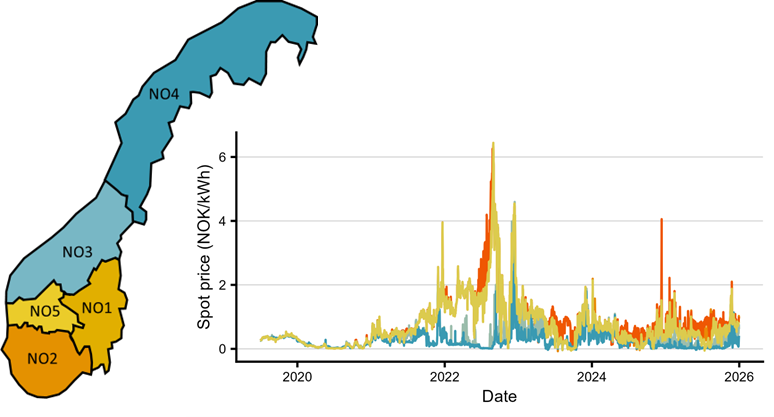
For many years, price-based demand response among Norwegian households was limited. Electricity prices were generally low and exhibited relatively little volatility, providing weak incentives for households to adjust consumption in response to hourly price signals. This situation changed abruptly in autumn 2021, when electricity prices increased sharply and volatility rose significantly, as illustrated in Figure 1. The main reason was a rapid increase in European natural gas prices, reflecting an increasingly tight gas market due to reduced Russian gas supplies already prior to the full‑scale invasion of Ukraine in February 2022. As gas‑fired power plants often set the marginal price in the electricity market, these developments led to higher wholesale electricity prices across Europe. Through integrated European electricity markets, this translated into higher and more volatile electricity prices in Norway, despite the fact that Norwegian electricity generation relies predominantly on hydro-power, complemented by wind power. As a result, electricity costs became highly visible for households, and price responsiveness became far more relevant.
Figure 1: Map of the Norwegian bidding zones (zonal pricing areas) grouped into South Norway (NO1, NO2, NO5) and North Norway (NO3, NO4) with their respective spot prices July 2019 – December 2025[3].
Empirical evidence indicates that while average households responded only weakly to hourly price variations, overall electricity consumption declined by approximately 11 to 14 per cent following the sharp increase in electricity prices from autumn 2021.[4] Another consequence was an increased adoption of smart technologies for controlling electricity consumption which increased households’ ability to respond to hourly electricity prices. These technologies include smart electric vehicle charging, smart electric water boilers, and control of electric space heating, which is widespread in Norway. Among these, smart electric vehicles (“EV”) charging plays an increasingly important role in price response.
BACKLASH AND WEAKENING OF PRICE SIGNALS
Despite the high prevalence of real-time pricing contracts, increased price levels and volatility have triggered a political and societal backlash against strong price exposure for households.[5] Importantly, this backlash has not primarily taken the form of households switching from real-time pricing contracts to fixed‑price contracts, which remain available. Instead, the backlash has mainly taken the form of government‑introduced electricity cost support schemes aimed at reducing household electricity costs, but with the side effect of substantially weakening or even removing the effective price signal faced by households.
Early support schemes were designed in a way that partially preserved incentives for price response. However, over time, the design of these schemes has increasingly weakened the link between spot prices and household electricity costs. This development culminated in October 2025 with the introduction of a fixed‑price scheme, commonly referred to as the “Norway price”, which effectively removes real‑time price exposure for participating households.
EVOLUTION OF NORWEGIAN ELECTRICITY SUPPORT SCHEMES
Norwegian electricity support schemes[6] have evolved since their introduction at the end of 2021 in response to the sharp increase in electricity prices. Each subsequent design change has affected how households face spot‑price signals, progressively weakening these incentives for changing their electricity consumption. It is important to bear in mind that these support schemes do not affect or replace retail electricity contracts, which for most households are based on real‑time pricing.
- Monthly electricity support scheme (introduced December 2021):[7]
Under the original monthly support scheme, the state compensated households a percentage of the electricity price exceeding a predefined threshold. While the parameters changed over time, the scheme ultimately covered 90 per cent of the price above the threshold of 0.70 NOK/kWh excluding VAT, with compensation paid via the grid tariff. The payout was calculated using the average monthly spot price and the household’s actual electricity consumption for the month. Since the compensation was based on the monthly average price, households still faced the full hourly price variation within the month. Shifting consumption from expensive hours to cheaper hours therefore reduced the electricity bill without affecting the level of support, preserving incentives for load shifting.
- Hourly electricity support scheme (introduced September 2023):[8]
Under the hourly electricity support scheme, compensation was based on the actual hourly spot price and the household’s electricity consumption in the corresponding hour, rather than on monthly average values. The threshold price was gradually increased and reached 0.77 NOK/kWh excluding VAT from January 2026, while the compensation rate remained at 90 per cent. This scheme substantially reduced incentives for load shifting during hours when prices exceeded the threshold, as 90 per cent of the price difference was reimbursed. Although households still faced price variation below the threshold, the overall strength of the price signal from spot prices was significantly weakened, particularly during high‑price periods when demand response would have been most valuable for the power system.
- “Norway price” (introduced October 2025):[9]
The “Norway price” is a voluntary, opt‑in support scheme. Households that do not opt in remain on the hourly electricity support scheme. The “Norway price” is a fixed electricity price set at 0.40 NOK/kWh excluding VAT. Households receive compensation via the grid tariff when the spot price exceeds the fixed price and have to pay the difference when it falls below this level. Once opted in, a household remains on the scheme until the end of the calendar year, although opt-in into the scheme can occur at any point during the year. In Southern Norway, where expected average spot prices for 2026 are significantly higher than 0.40 NOK/kWh, the scheme is highly attractive. As of April 2026, approximately two‑thirds of households in the southern bidding zones had opted into the Norway price.[10] By design, the scheme effectively removes all short‑term price signals for households with “Norway price”.
FIRST EVIDENCE ON THE EFFECTS OF THE “NORWAY PRICE” ON THE ELECTRICITY CONSUMPTION
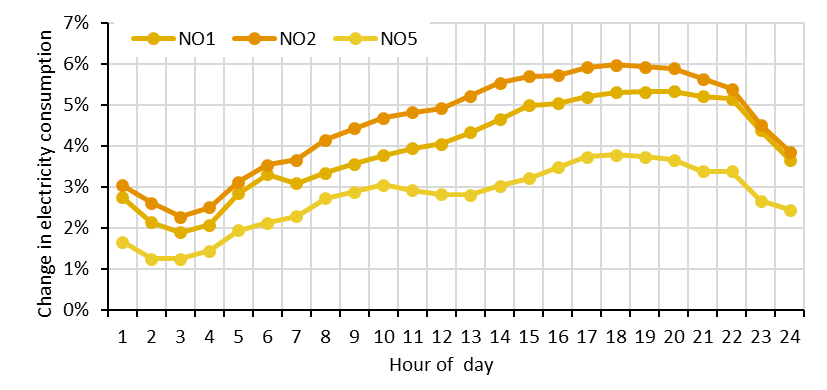
Early, not‑yet‑published empirical analyses[11] indicate two main effects of the “Norway price”. First, household with “Norway price” increase their electricity consumption by a few per cent compared with households that remain on the hourly electricity support scheme within the same bidding zone, as shown in Figure 2. This can be explained by the lower electricity price and the resulting weaker incentive to conserve electricity. Second, the increase in consumption appears to follow the typical household load profile, with relatively larger percentage increases in the afternoon and evening hours, as seen in Figure 3. This implies that electricity consumption increases particularly during peak load hours. One plausible explanation is that households on the fixed-price scheme reduce load shifting to nighttime hours with lower spot prices. As a result, the removal of real‑time price signals not only increases total consumption but may also exacerbate peak demand at system level.
Figure 2: Change in household electricity consumption during the winter months among households enrolled in the “Norway price” scheme, after the scheme was introduced[12]
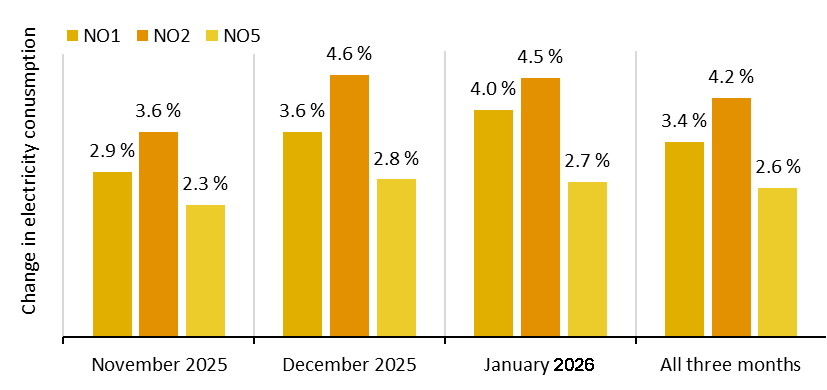
Figure 3: Change in household electricity consumption by hour of day in January 2026 among households enrolled in the “Norway price” scheme[13]
CONCLUSION
Norway provides an interesting case for assessing real‑time pricing for households, combining near complete exposure to hourly spot prices with policy interventions during periods of high and volatile electricity prices. The experience since autumn 2021 shows that strong price signals can matter: although average households responded only weakly to short‑term hourly price variation, high prices led to a substantial reduction in aggregate electricity consumption and accelerated the adoption of smart technologies to control electricity consumption. At the same time, the subsequent introduction of various electricity support schemes has progressively weakened household exposure to real‑time price signals. Emerging evidence suggests that this removal of price incentives increases electricity consumption and may increase peak demand at system level by reducing load shifting.
In summary, the Norwegian case underscores that the effectiveness of real‑time pricing for households depends not only on retail contract design and technology, but also on the surrounding policies aimed at lowering electricity costs for households and their effects on household price exposure.

Comment on Ahmad Faruqui, “Real Time Pricing of Electricity for Households: An International Survey”[1]
INTRODUCTION
In his international survey on real-time pricing for households, Faruqui highlights Norway as a prominent example, due to its exceptionally high share of households on electricity contracts tied to the hourly day-ahead spot price. Recent figures show that approximately 97 per cent of Norwegian households have real-time pricing retail contracts.[2] This widespread adoption makes Norway a particularly relevant case for assessing both the potential and the limitations of real-time pricing in practice. Thus, I aim to inform readers about recent developments in real-time pricing in Norway.
For many years, price-based demand response among Norwegian households was limited. Electricity prices were generally low and exhibited relatively little volatility, providing weak incentives for households to adjust consumption in response to hourly price signals. This situation changed abruptly in autumn 2021, when electricity prices increased sharply and volatility rose significantly, as illustrated in Figure 1. The main reason was a rapid increase in European natural gas prices, reflecting an increasingly tight gas market due to reduced Russian gas supplies already prior to the full‑scale invasion of Ukraine in February 2022. As gas‑fired power plants often set the marginal price in the electricity market, these developments led to higher wholesale electricity prices across Europe. Through integrated European electricity markets, this translated into higher and more volatile electricity prices in Norway, despite the fact that Norwegian electricity generation relies predominantly on hydro-power, complemented by wind power. As a result, electricity costs became highly visible for households, and price responsiveness became far more relevant.
Figure 1: Map of the Norwegian bidding zones (zonal pricing areas) grouped into South Norway (NO1, NO2, NO5) and North Norway (NO3, NO4) with their respective spot prices July 2019 – December 2025[3].
Empirical evidence indicates that while average households responded only weakly to hourly price variations, overall electricity consumption declined by approximately 11 to 14 per cent following the sharp increase in electricity prices from autumn 2021.[4] Another consequence was an increased adoption of smart technologies for controlling electricity consumption which increased households’ ability to respond to hourly electricity prices. These technologies include smart electric vehicle charging, smart electric water boilers, and control of electric space heating, which is widespread in Norway. Among these, smart electric vehicles (“EV”) charging plays an increasingly important role in price response.
BACKLASH AND WEAKENING OF PRICE SIGNALS
Despite the high prevalence of real-time pricing contracts, increased price levels and volatility have triggered a political and societal backlash against strong price exposure for households.[5] Importantly, this backlash has not primarily taken the form of households switching from real-time pricing contracts to fixed‑price contracts, which remain available. Instead, the backlash has mainly taken the form of government‑introduced electricity cost support schemes aimed at reducing household electricity costs, but with the side effect of substantially weakening or even removing the effective price signal faced by households.
Early support schemes were designed in a way that partially preserved incentives for price response. However, over time, the design of these schemes has increasingly weakened the link between spot prices and household electricity costs. This development culminated in October 2025 with the introduction of a fixed‑price scheme, commonly referred to as the “Norway price”, which effectively removes real‑time price exposure for participating households.
EVOLUTION OF NORWEGIAN ELECTRICITY SUPPORT SCHEMES
Norwegian electricity support schemes[6] have evolved since their introduction at the end of 2021 in response to the sharp increase in electricity prices. Each subsequent design change has affected how households face spot‑price signals, progressively weakening these incentives for changing their electricity consumption. It is important to bear in mind that these support schemes do not affect or replace retail electricity contracts, which for most households are based on real‑time pricing.
Under the original monthly support scheme, the state compensated households a percentage of the electricity price exceeding a predefined threshold. While the parameters changed over time, the scheme ultimately covered 90 per cent of the price above the threshold of 0.70 NOK/kWh excluding VAT, with compensation paid via the grid tariff. The payout was calculated using the average monthly spot price and the household’s actual electricity consumption for the month. Since the compensation was based on the monthly average price, households still faced the full hourly price variation within the month. Shifting consumption from expensive hours to cheaper hours therefore reduced the electricity bill without affecting the level of support, preserving incentives for load shifting.
Under the hourly electricity support scheme, compensation was based on the actual hourly spot price and the household’s electricity consumption in the corresponding hour, rather than on monthly average values. The threshold price was gradually increased and reached 0.77 NOK/kWh excluding VAT from January 2026, while the compensation rate remained at 90 per cent. This scheme substantially reduced incentives for load shifting during hours when prices exceeded the threshold, as 90 per cent of the price difference was reimbursed. Although households still faced price variation below the threshold, the overall strength of the price signal from spot prices was significantly weakened, particularly during high‑price periods when demand response would have been most valuable for the power system.
The “Norway price” is a voluntary, opt‑in support scheme. Households that do not opt in remain on the hourly electricity support scheme. The “Norway price” is a fixed electricity price set at 0.40 NOK/kWh excluding VAT. Households receive compensation via the grid tariff when the spot price exceeds the fixed price and have to pay the difference when it falls below this level. Once opted in, a household remains on the scheme until the end of the calendar year, although opt-in into the scheme can occur at any point during the year. In Southern Norway, where expected average spot prices for 2026 are significantly higher than 0.40 NOK/kWh, the scheme is highly attractive. As of April 2026, approximately two‑thirds of households in the southern bidding zones had opted into the Norway price.[10] By design, the scheme effectively removes all short‑term price signals for households with “Norway price”.
FIRST EVIDENCE ON THE EFFECTS OF THE “NORWAY PRICE” ON THE ELECTRICITY CONSUMPTION
Early, not‑yet‑published empirical analyses[11] indicate two main effects of the “Norway price”. First, household with “Norway price” increase their electricity consumption by a few per cent compared with households that remain on the hourly electricity support scheme within the same bidding zone, as shown in Figure 2. This can be explained by the lower electricity price and the resulting weaker incentive to conserve electricity. Second, the increase in consumption appears to follow the typical household load profile, with relatively larger percentage increases in the afternoon and evening hours, as seen in Figure 3. This implies that electricity consumption increases particularly during peak load hours. One plausible explanation is that households on the fixed-price scheme reduce load shifting to nighttime hours with lower spot prices. As a result, the removal of real‑time price signals not only increases total consumption but may also exacerbate peak demand at system level.
Figure 2: Change in household electricity consumption during the winter months among households enrolled in the “Norway price” scheme, after the scheme was introduced[12]
Figure 3: Change in household electricity consumption by hour of day in January 2026 among households enrolled in the “Norway price” scheme[13]
CONCLUSION
Norway provides an interesting case for assessing real‑time pricing for households, combining near complete exposure to hourly spot prices with policy interventions during periods of high and volatile electricity prices. The experience since autumn 2021 shows that strong price signals can matter: although average households responded only weakly to short‑term hourly price variation, high prices led to a substantial reduction in aggregate electricity consumption and accelerated the adoption of smart technologies to control electricity consumption. At the same time, the subsequent introduction of various electricity support schemes has progressively weakened household exposure to real‑time price signals. Emerging evidence suggests that this removal of price incentives increases electricity consumption and may increase peak demand at system level by reducing load shifting.
In summary, the Norwegian case underscores that the effectiveness of real‑time pricing for households depends not only on retail contract design and technology, but also on the surrounding policies aimed at lowering electricity costs for households and their effects on household price exposure.
1 Ahmad Faruqui, “Real Time Pricing of Electricity for Households: An International Survey” (April 2025) 13:3 Energy Regulation Q, online: <energyregulationquarterly.ca/articles/real-time-pricing-of-electricity-for-households-an-international-survey>.
* Matthias Hofmann is a Senior Advisor at Statnett, the Norwegian transmission system operator, working on system utilisation and flexibility in power systems. Prior to this role, he held several positions at Statnett and SINTEF—one of Europe’s largest independent research organisations—focusing on power system analysis and research program management. He holds a PhD from NTNU on demand-side flexibility as an alternative to grid investments, and a Master’s degree in Industrial Engineering and Management from Technische Universität Ilmenau. His work focuses on electricity market design, demand flexibility, and security of supply, combining empirical analysis and applied research in the Norwegian and European power systems.
2 Statistics Norway, Breakdown of Electricity Sales: Electricity Prices in the End-User Market, by Type of Contract and Quarter, table 14491 (16 February 2026), online: Statistics Norway <ssb.no/en/statbank/table/14491?sq=30120598>.
3 This graphic was designed by the author of the present article using data collected from the following database: Nord Pool, “Day-ahead Prices” (last accessed 29 May 2026), online: Nord Pool <data.nordpoolgroup.com/auction/day-ahead/prices?deliveryDate=latest¤cy=EUR&aggregation=DeliveryPeriod&deliveryAreas=AT>.
4 Matthias Hofmann & Hanne Sæle, “A Comparative Analysis of Implicit Demand Side Response among Norwegian Electricity Consumers during the 2022/23 Energy Crisis”, presented at CIGRE Paris Session 2024. See also Matthias Hofmann & Karen Byskov Lindberg, “Residential Demand Response and Dynamic Electricity Contracts with Hourly Prices: A Study of Norwegian Households during the 2021/22 Energy Crisis” (February 2024) 13 Smart Energy 100126, online: <doi.org/10.1016/j.segy.2023.100126>.
5 Tone Sofie Aglen, “Strømspøkelset er tilbake”, NRK (12 December 2024), online: <nrk.no/ytring/stromspokelset-er-tilbake-1.17166606> [in Norwegian].
6 Government of Norway, Støtte til husholdninger — Innretning på strømstønadsordningen de siste årene, online: Regjeringen <regjeringen.no/no/tema/energi/strom/regjeringens-stromtiltak/id2900232> [in Norwegian].
7 Office of the Prime Minister, Ministry of Energy & Ministry of Finance (Norway), “Government Launches Electricity Support Package Worth Billions” (11 December 2021), online: Regjeringen <regjeringen.no/en/whats-new/government-launches-electricity-support-package-worth-billions/id2891839>.
8 Ministry of Energy (Norway), “Mer treffsikker strømstønadsordning til husholdningene” (11 May 2023), online: Regjeringen <regjeringen.no/no/aktuelt/mer-treffsikker-stromstonadsordning-til-husholdningene/id2976901> [in Norwegian].
9 Ministry of Energy (Norway), “Norway Price to Ensure Predictable and Stable Electricity Prices for Consumers” (17 March 2025), online: Regjeringen <regjeringen.no/en/whats-new/norgespris-skal-sikre-forutsigbare-og-stabile-strompriser-for-folk/id3090849>.
10 Elhub, Statistikk for Norgespris, online: Elhub <elhub.no/data-og-innsikt/statistikk-for-norgespris> [in Norwegian].
11 Kristine Johanne Viddal Moen, Synne Lefdal, Matthias Hofmann & Karen Byskov Lindberg, “Lower Electricity Prices, Higher Demand? — The Effect of Introducing a Subsidized Flat Electricity Price to Norwegian Households” (paper accepted at the 22nd International Conference on European Energy Market (EEM 2026), Trondheim, Norway, 22–24 June 2026) [unpublished].
12 Ibid.
13 Ibid.