
Quebec is the fourth largest energy-producing province after Alberta, British Columbia and Saskatchewan, and the third largest overall consumer after Ontario and Alberta according to 2024 data[1]. However, its energy mix is quite different from that of Canada’s other provinces. Unlike Alberta, British Columbia and Saskatchewan, Quebec does not produce hydrocarbons. Nor does it generate any nuclear energy, which Ontario and, to a lesser extent, New Brunswick do. Hydroelectricity is what characterizes Quebec when it comes to energy production. More than 50 per cent of Canada’s hydroelectricity is produced in Quebec, which also produces close to 25 per cent of Canada’s wind energy[2]. This article provides an overview of energy in Quebec along three major axes: (1) energy profile; (2) the energy sector; and (3) tomorrow’s challenges.
ENERGY PROFILE
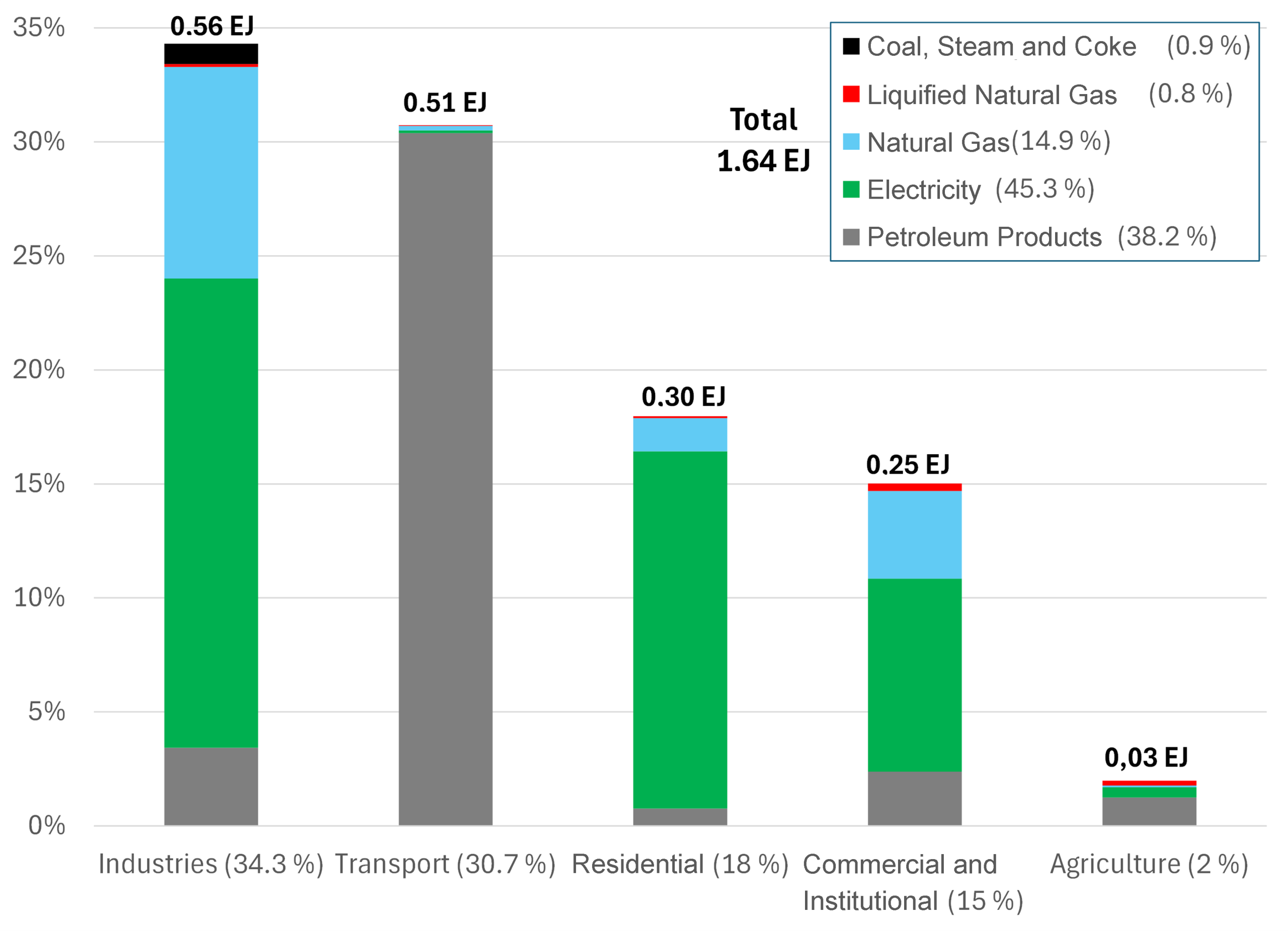
Even though its hydroelectricity and wind energy production make Quebec the top renewable energy producer in Canada, more than 50 per cent of its energy consumption nonetheless rests on hydrocarbons: 36 per cent refined petroleum products, 14 per cent natural gas, and around 1 per cent propane and other forms of liquefied natural gas, as well as coal[3]. All of those hydrocarbons come from outside Quebec. Electricity (41 per cent) and biomass (8 per cent) top up the consumption. Graph 1 illustrates this profile, excluding biomass which is not included in Statistics Canada’s detailed statistics.
Graph 1: Quebec’s energy profile (biomass not included), with percentage of total demand, 2024[4]
Petroleum products
Although all of the hydrocarbons are imported, Quebec has two major refineries: Valero in Lévis (with a 265,000 barrels per day capacity), and Suncor in Montréal (137,000 barrels per day)[5]. Both refineries are next to the St. Lawrence River and close to pipelines. This strategic positioning enables them to receive crude oil from several sources and to distribute their production to several markets. The total refining capacity of slightly over 400,000 barrels a day is greater than the consumption of refined petroleum products in Quebec, which has held steady at less than 350,000 barrels a day for several years.
Petroleum products remain truly significant only for transportation, where they represent almost all of the energy consumed. In the transportation sector (30.7 per cent of the province’s consumption), road transportation dominates, with 24.2 per cent of the province’s energy, compared to 4.8 per cent for air, 1 per cent for maritime, 0.4 per cent for rail and 0.1 per cent for pipelines.
Although electric vehicle sales (EVs being battery electric vehicles and rechargeable electric hybrids) have come much farther in Quebec than elsewhere in Canada, gasoline and diesel consumption has not fallen and remains stable. They have been in the range of 9 billion and 3 billion litres annually since 2016[6].
In 2024, Quebec’s automobile fleet had the highest proportion of EVs at 4.8 per cent compared to the Canadian average of 2.6 per cent[7]. Gasoline sales come to around 1,000 litres annually per inhabitant, which is equivalent to the volume sold per inhabitant in Ontario, and slightly less than the Canadian average of close to 1,100 litres. Annual diesel sales per inhabitant were 340 litres in 2024, below the Canadian average of 415 litres.
Electricity
Of all the provinces, Quebec is the one with the highest penetration of electricity. With more than 40 per cent of final consumption provided by this form of energy, the province is well above the 24 per cent, on average, characterizing the rest of Canada[8]. As illustrated in Graph 2, Quebec has a very high consumption of electricity per inhabitant, with one of the lowest kilowatt-hour (“kWh”) prices in Canada[9]. With its population of 9 million inhabitants (compared to 16 million in Ontario and close to 6 and 5 million in British Columbia and Alberta), Quebec’s electricity consumption easily surpasses that of all the other provinces: 171 terawatt-hours (“TWh”) in 2024, compared to 135 TWh for the second province in line, Ontario.
Graph 2: Total sales of electricity per inhabitant and per kilowatt-hour, 2024[10]
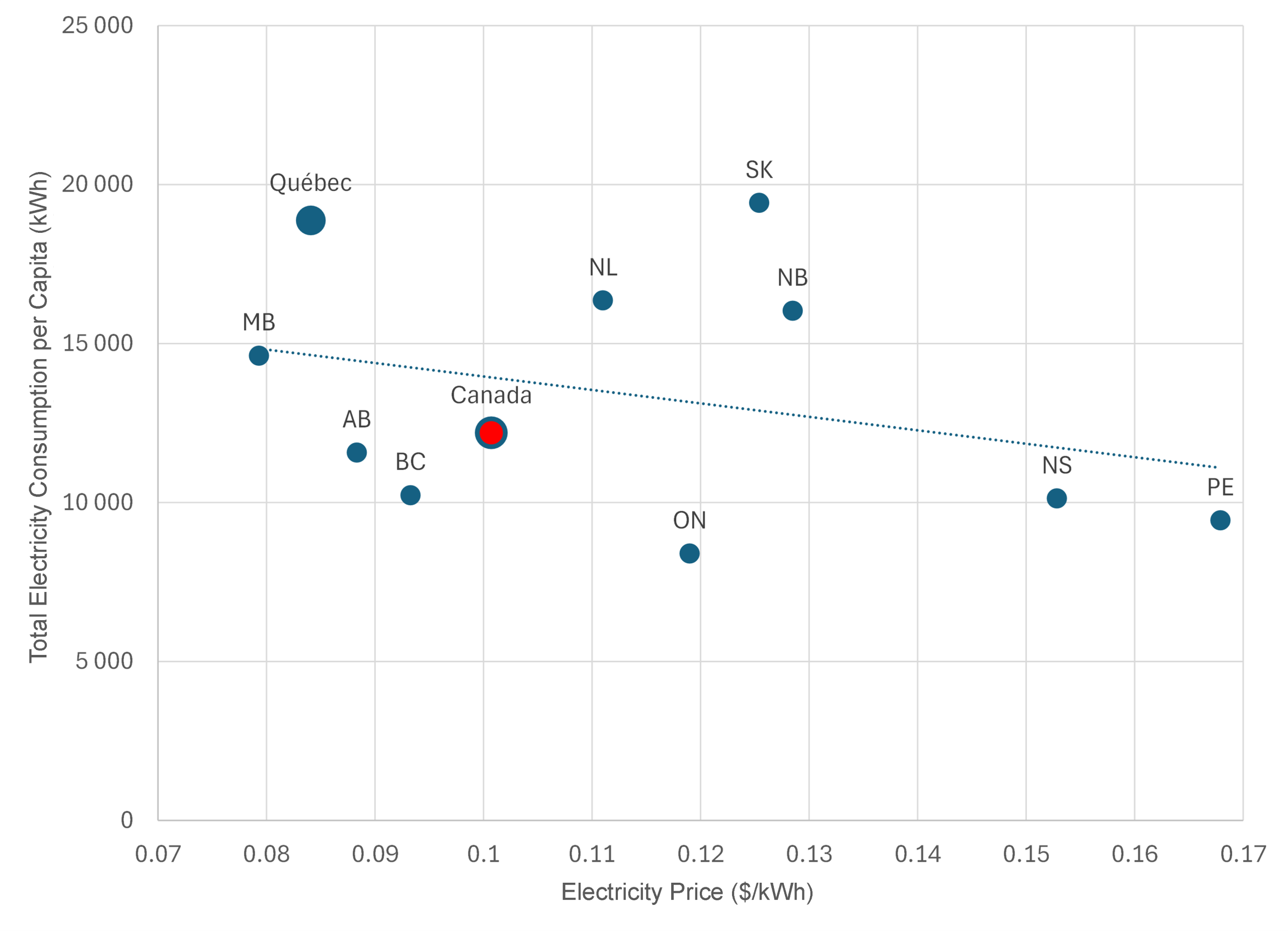
Clearly, the tremendous availability of hydroelectricity and its low price account for this high consumption. This translates into residential, commercial and industrial energy consumption being dominated by electricity. Thus, as Graph 1 illustrates, more than 50 per cent of the energy in these sectors comes from this source.
Natural gas
In Quebec, natural gas amounts to less than 15 per cent of total consumption, well below the 37 per cent for Canada, making this energy less of a central presence in the province’s profile. Nonetheless, it remains significant for the industrial sector and in buildings, particularly commercial and institutional buildings.
Renewable natural gas (“RNG”) production is on the rise in Quebec, with 124 million cubic metres (“m3”) in 2024, whereas 10 years earlier it was nonexistent. It represents 2 per cent of the 6,195 million cubic metres consumed.
Biomass
As in the rest of Canada, Quebec’s biomass sector lacks visibility, particularly because it is largely excluded from the energy statistics released by Statistics Canada. However, Natural Resources Canada reports that in 2023, firewood accounted for 12 per cent of residential consumption, as well as 12 per cent of industrial consumption (wood waste and black liquor)[11].
Liquid biofuels are also produced in Quebec, dominated by Greenfield Global, which owns a plant with a capacity of 200 million litres annually, turning corn into ethanol. Small producers of biodiesel (12 million litres annually) and pyrolysis oil (16 million litres annually) contribute to the production of liquid biofuels[12]. But this production remains marginal compared to total annual consumption of approximately 20 billion litres of petroleum products. In 2024, Quebec imported 1.2 billion litres of biofuel[13] to meet minimum ethanol and biodiesel content obligations for gas and diesel.
THE ENERGY SECTOR
As with most of Canada’s provinces, Quebec’s energy sector is essentially organized around two rather traditional models: the competitive petroleum products sub-sector and the largely regulated electricity sub-sector. Between petroleum products and electricity lies the natural gas sub-sector, which combines a higher level of competition for the energy component with highly regulated transportation and distribution services. Finally, there is the biomass sector, which is fragmented, with little structure or regulation.
Graph 3 illustrates the main institutions and key players in Quebec’s regulated energy sub-sectors. The ministère de l’Économie, de l’Innovation et de l’Énergie (“MEIE”) plays an important role as the department responsible for Hydro-Québec, the Crown corporation in charge of the electricity sector. It is also responsible for appointing the commissioners of the Régie de l’énergie, the administrative tribunal that sets the rates for electricity and for natural gas distribution. The MEIE also seeks to provide clearer direction to the energy sector with its recent Bill 69, passed in June 2025. The Bill calls for the establishment and implementation of an integrated energy resource management plan. That plan aims to orchestrate the different energy players to lead Quebec to carbon neutrality.
Graph 3: Key institutions and players in Quebec’s energy sector
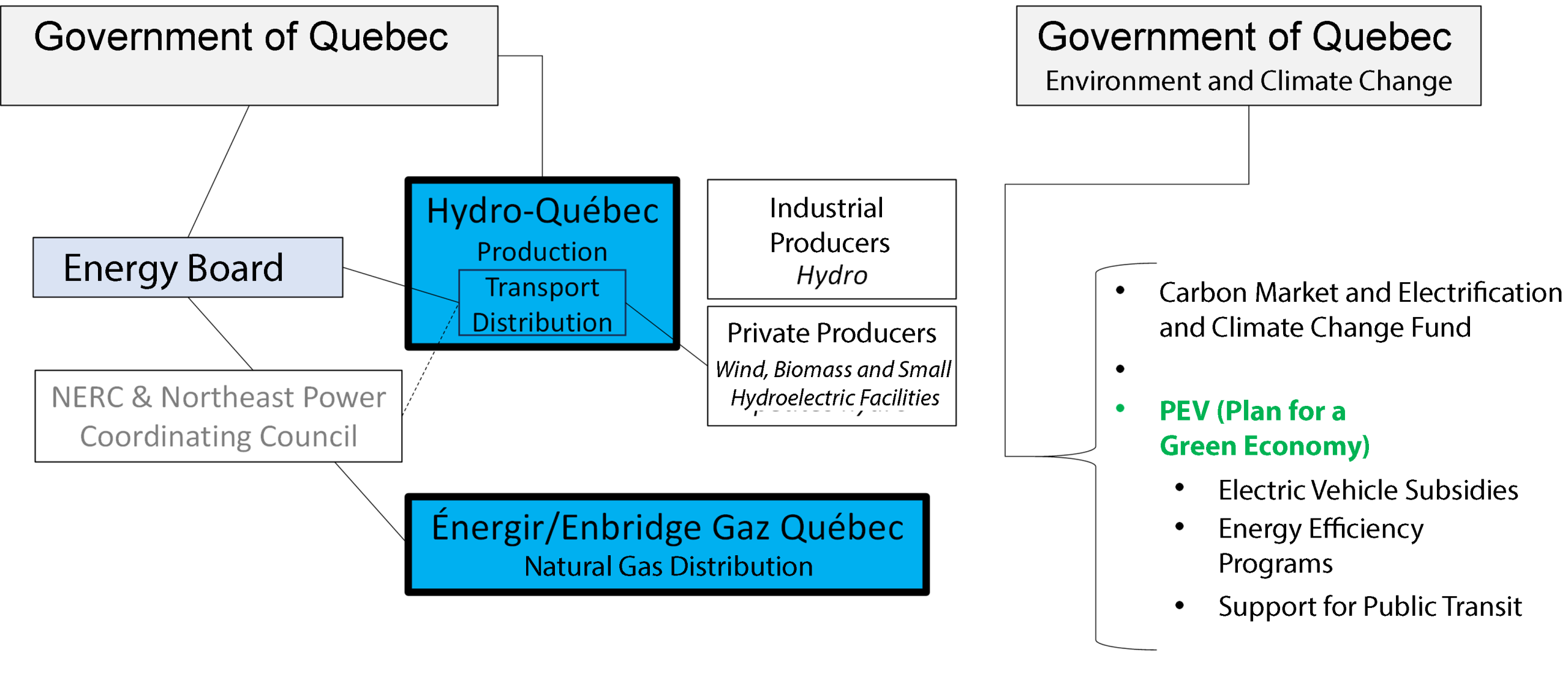
The ministère de l’Environnement, de la Lutte contre les changements climatiques, de la Faune et des Parcs (“MELCCFP”) plays a key but less direct role in the energy sector. That role is exercised through carbon pricing and the energy efficiency programs it deploys. Its actions directly affect the use of petroleum products and natural gas through the additional cost tagged onto their price in the carbon market, known as the cap-and-trade system (“SPEDE”) applied to greenhouse gas (“GHG”). It is also the department responsible for the Plan for a Green Economy (“PEV”), Quebec’s electrification and climate change policy framework designed to help achieve the province’s climate goals.
The following sub-sections provide an overview of the situation in which the four main energy sub-sectors find themselves.
Petroleum products
The petroleum products market is fully open to competition. Crude oil is shipped to refineries according to the type of transportation chosen by the refiners – pipeline, ship or train. The price of that crude oil is freely set by the market. However, pipeline user fees are monitored by the Canada Energy Regulator to ensure there is no abuse of market power and that services are fair, reasonable and non-discriminatory.
Refiners sell their production to petroleum product distributors, which have the option of importing those products. The price of each petroleum product is set by the market.
However, since 2015, petroleum product distributors have been subject to SPEDE. They must obtain GHG emission rights equivalent to that which will be released into the atmosphere by the combustion of those products. Thus, in 2021-2023, petroleum product emitter-distributors such as Harnois, Irving, Norcan, Imperial Oil, Shell Canada Products, and others had to purchase emission rights to cover the emission of 117 million tonnes (“Mt”) of GHG related to the combustion of their products[14]. At approximately $40/tonne, that corresponds to $4.7 billion. This cost of carbon added 8.4 ¢/litre to the price of gasoline.
The selling price of petroleum products is monitored by the Régie de l’énergie du Québec, but is not regulated. There used to be a threshold price to protect independent service stations, but it was abolished in June 2025 with the passage of Bill 69. That Bill did increase the transparency of pricing by service stations. They are now required to disclose the selling prices of gasoline and diesel to the Régie de l’énergie, which posts that information in real time for all service stations in Quebec.[15]
Electricity
The Quebec government is far more involved in the electricity sub-sector. Hydro-Québec is a Crown corporation with a monopoly over hydro production by projects generating more than 50 megawatts (“MW”) unless production rights have been assigned to industrial producers (as is the case with Rio Tinto). Hydro-Québec also has a monopoly on electricity transmission and distribution. It should be noted that 10 municipal distributors or cooperatives co-exist with Hydro-Québec. Those distributors were not nationalized in 1962, when 11 private distributors were put under the control of Hydro-Québec[16]. However, they are much smaller and only serve 170,000 customers compared to the more than 4.4 million customers served by Hydro-Québec.
Electricity production in Quebec is not regulated, and neither is the price of electrical energy sold to Hydro-Québec. However, it is the sole buyer that must ensure the electricity supply for its industrial, commercial and residential customers. The rates offered to Hydro-Québec customers are regulated by the Régie de l’énergie.
Hydro-Québec, as part of its distribution activities, has four sources of electricity:
- Heritage pool. A 165 terawatt-hour (“TWh”) heritage pool at a price set under the Act respecting the Régie de l’énergie is available to Hydro-Québec. The price is indexed annually to inflation, and in 2025 came to approximately 3.3 ¢/kWh[17].
- Post-heritage contracts. Given that Quebec’s requirements exceed 165 TWh, Hydro-Québec has signed long-term supply contracts, known as post-heritage, with itself (Hydro-Québec, in its production activities) and with private producers. Those contracts supplied 18 TWh in 2025 at an average cost of 11.7 ¢/kWh.
- Short-term purchases. Hydro-Québec also buys electricity from neighbouring markets such as Ontario, New York, New England and New Brunswick. These spot purchases amount to a few TWh. In 2025, they were purchased at an average cost of 13.4 ¢/kWh.
- Demand management. Finally, Hydro-Québec has demand management tools (interruptible options, dynamic pricing) it can use with its customers, enabling it to reduce its supplies in return for compensation, lower than short-term market prices.
Thus, the rates charged to customers, approved by the Régie de l’énergie, consist of these electricity supply costs (not regulated by the Régie de l’énergie), transmission costs (regulated) and distribution costs (regulated). For the transmission and distribution costs, investments must be approved, particularly those associated with energy efficiency.
The rate structures used by Hydro-Québec are very simple:
- a daily fixed rate (residential or small commercial customers) or a demand charge, based on the maximum power in kW used in a month (commercial and industrial customers); or
- a price per kWh consumed, with a second higher price range for residential customers and a second lower price range for commercial customers. Industrial customers have only one price per kWh.
Some customers choose optional dynamic rates, and different rate options exist for certain cases. As illustrated in Graph 2, the dollar value of kWh sold by Hydro-Québec is among the lowest in Canada, reflecting the relatively low price enjoyed by customers.
Cross-subsidization reduces the rates paid by residential customers by almost 20 per cent, to the detriment of commercial customers which pay 27 per cent more than would be justified by their service costs. Industrial customers pay approximately 15 per cent more than would be justified by their service costs.[18]
Hydro-Québec, in its production activities, is also a very active player on the American northeast electricity scene. It takes advantage of its enormous reservoirs, which can hold up to 176 TWh of energy, and of its central position between the open markets in Ontario, New York and New England for electrical energy transactions. Two major 10 TWh per year long-term export contracts have been signed with Massachusetts (20 years) and New York (25 years). Those contracts led to the construction of two new transmission lines to those states, which will be commissioned in 2026.
Natural gas
Énergir is the largest natural gas distributor in Quebec. It covers the greater Montréal area to Québec, as well as southern Quebec and an extension to Lac St-Jean. It delivers natural gas to some 210,000 customers. The Gatineau area, in the Outaouais, has its natural gas needs met by Enbridge Gaz Québec through a separate system that supplies just over 40,000 customers[19].
Major customers (consuming more than 7,500 m³ annually) can choose their natural gas supplier. Different companies sell natural gas that they purchase on the North American market.
The two natural gas distributors bill customers for distribution, transportation and supply if they have not opted for another supplier. In addition to those costs, there are SPEDE costs, as for petroleum product distributors. On December 1, 2025, the price of carbon, which is adjusted every quarter, represented 8.587 ¢/m³[20].
Énergir customers can choose to purchase RNG rather than fossil natural gas. RNG costs more, but the fact that it is renewable exempts it from the purchase of emission rights under SPEDE. As of October 1, 2025, the price of RNG was 94.884 ¢/m3 (equivalent to $25.04/GJ)[21]. By comparison, fossil natural gas sold for 15.308 ¢/m3 ($4.04/GJ) on April 1, 2026[22].
Énergir is required to sell 5 per cent of RNG annually to its customers between 2025 and 2030, and that proportion will increase to 10 per cent in 2030. The volumes required to reach those targets, that were not voluntarily purchased by customers, are paid by customers through a socialization fee. That helps recover the higher costs of purchasing RNG. The Régie de l’énergie approves supply contracts that Énergir negotiates with RNG suppliers.
Biomass
Energy from biomass takes different forms: firewood, wood pellets, forest residues, ethanol and RNG. The suppliers of these products come from the agricultural sector, the agri-food sector, waste management, the forest industry and the intersection of these sectors.
The government’s intervention in this sub-sector is very limited, except for renewable energy content obligations in natural gas, gasoline and diesel. The RNG issue is covered above. For gasoline and diesel, the Government of Quebec sets minimum volume proportions for low-carbon intensity content, which must be integrated into the total volume of gasoline or diesel distributed. Since 2025, these minimum proportions are 12 per cent for gasoline and 5 per cent for diesel, and will rise progressively to 15 per cent and 10 per cent, respectively, in 2030[23].
These low-carbon intensity contents include[24]:
- biofuels such as ethanol and biodiesel;
- fuels produced from atmospheric CO2 and green hydrogen such as e-diesel; and
- fuels produced by converting synthesis gas into hydrocarbons, such as renewable gasoline produced from non-recyclable plastic.
It should be noted that mandatory integration of low-intensity carbon content into gasoline and diesel fuel in Quebec is an obligation in addition to those under the federal Clean Fuel Regulations (“CFR”), and their reporting mechanisms are distinct.
TOMORROW’S CHALLENGES
Quebec’s energy sector has two big things going for it. First, its tremendous capacity for producing low-cost renewable electrical energy. Second, an already high degree of electrification, which gives it a head start over other provinces in the economy’s decarbonization.
All the same, the province is up against a number of significant challenges, summarized here as three major ones: reaching the GHG reduction targets, the evolution of the price of electricity, and the development of biofuels.
Reaching the GHG reduction targets
With 8.9 tonnes of GHG per inhabitant in 2023, Quebec is the province with the lowest emissions per person. It is also the province most open about its climate ambitions, aiming for a reduction of 37.5 per cent under the 1990 level by 2035 (in January 2026, the timeline was changed from 2030 to 2035[25]). With its carbon market (SPEDE) linked to California’s, Quebec has established a binding mechanism that mechanically pressures GHG emissions. It is the only province in Canada that has an absolute ceiling on a large portion of its emissions (approximately 75 per cent). Only agriculture, waste and certain transportation modes (air and maritime) are not subject to SPEDE.
Yet, despite its current strong position and SPEDE, Quebec’s GHG emissions reduction trajectory will not reach its target by 2035. The energy sector represents 70 per cent of its GHG emissions, so significant reductions will have to take place in this sector before its target is reached.
Despite the PEV and its different initiatives (see Graph 3), Quebec has still not managed to reduce its consumption of petroleum products or natural gas. No reforms are in sight for the transportation sector to make it more efficient and reduce its energy consumption. The same applies to buildings and industry: discussions are taking place around energy efficiency and electrification, but without any significant break from the past. Electrification is presented as the best way to decarbonize. Quebec already has a highly developed electricity sector. Will it be able to evolve it to decarbonize through electrification?
Evolution of the price of electricity and electrification
The low price of electricity in Quebec has pushed its penetration into heating for buildings and industry. Consequently, electricity consumption in Quebec is higher than elsewhere, and its electricity system is bigger. Hydro-Québec’s objective for 2035 is to add 60 TWh of energy for new uses, which is a very ambitious target to reach in less than 10 years. This new capacity will cost far more than the electricity in the heritage pool: already the leap from heritage power (3.3 ¢/kWh) to post-heritage (11.7 ¢/kWh) is enormous: more than 8 ¢/kWh! Users are nowhere near prepared to pay the marginal cost of production of new supplies. The setting of rates based on average cost is seldom challenged. Any increase in that average cost even triggers negative reactions–indeed, calls into question the projects causing the increases.
That amounts to a very poor price signal, pushing for overconsumption instead of true efforts towards energy efficiency.
Thus, Quebecers are blind to the real costs of electricity supply, even as a lot of new capacity would have to be added to electrify. That makes for a very weak economic foundation, which risks throwing off the current balance.
Biofuel development
Even with successful electrification and a reduction in needs that could be achieved through greater energy efficiency, gaseous and liquid biofuels will have their place in a decarbonized society. Certain uses are simply less conducive to electrification (utility/work vehicles, planes, certain industrial processes, etc.).
Thus, the energy system’s resilience will benefit from a diversity of supply sources, even a degree of redundancy. In the event of a power failure, those biofuels will be invaluable.
Energy security and self-sufficiency will also benefit if biomass is promoted in shorter and/or circular circuits.
For all of these reasons, it would be important to develop a more coherent biofuel sub-sector. Quebec already has a number of biofuel producers, but the sector is fragmented and few players manage to succeed, even less secure a place, in any convincing way.
CONCLUSION
Quebec’s energy profile stands out for its high proportion of renewable electricity and for stronger decarbonization ambitions than elsewhere in Canada. Nonetheless, the challenges it faces are quite similar: succeed in getting on a trajectory of GHG emission reduction aligned with its targets, reform its electricity market to give it more solid economic foundations, and boost biofuels to give them a chance to fully take their place.
A more extensive dialogue with the other provinces could help more quickly advance on those three fronts given that they are all facing the same issues. But first, a diagnostic more openly shared by Quebec’s players would not be without value in enabling a more coordinated effort.
-
* Pierre-Olivier Pineau is a Full Professor at HEC Montréal and has held the Chair in Energy Sector Management since 2013. A specialist in energy policy and the electricity sector, he regularly publishes on the relationship between energy and sustainable development. His book, L’équilibre énergétique, received the 2024 Hubert-Reeves Prize for Scientific Popularization.
1 Statistics Canada, Supply and demand of primary and secondary energy in terajoules, Table 25-10-0029-01 (2025).
-
2 Statistics Canada, Electric power generation, monthly generation by type of electricity, Table 25-10-0015-01 (2025).
-
3 Johanne Whitmore & Pierre-Olivier Pineau, L’état de l’énergie au Québec 2026 (Montréal: Chaire de gestion du secteur de l’énergie, HEC Montréal, 2026).
-
4 Supra note 1.
-
5 Canadian Fuels Association, “Fuel Production” (last accessed 7 May 2026), online: <canadianfuels.ca/industry-facts/conventional-fuels/fuel-production>.
-
6 Statistics Canada, Sales of fuel used for road motor vehicles, annual, Table 23-10-0066-01 (2025).
-
7 Statistics Canada, Vehicle registrations, by type of vehicle and fuel type, Table 23-10-0308-01 (2025).
-
8 This 24 per cent comes from Statistics Canada, Supply and demand of primary and secondary energy in terajoules, see supra note 1. It should be noted that biomass is not included in these energy statistics even though it represents more than 5 per cent of consumption according to the International Energy Agency, online: <iea.org/countries/canada/energy-mix>. Thus, in reality, the proportion of electricity is less.
-
9 Statistics Canada, Electric power, electric utilities and industry, annual supply and disposition, Table 25-10-0021-01 (2025).
-
10 Statistics Canada, Supply and demand of primary and secondary energy in natural units, Table 25-10-0030-01 (13 November 2025).
-
11 Natural Resources Canada, Comprehensive Energy Use Database (2025).
-
12 Supra note 3.
-
13 Supra note 10.
-
14 Ministère de l’Environnement, de la Lutte contre les changements climatiques, de la Faune et des Parcs (Québec) Rapport de couverture des émissions de la période 2021-2023 du système de plafonnement et d’échange de droits d’émission de gaz à effet de serre (SPEDE) du Québec, report released on December 6, 2024, updated on October 14, 2025.
-
15 Gouvernement du Québec, Régie Essence Québec (last accessed 7 May 2026), online: <regieessencequebec.ca>.
-
16 Hydro-Québec, “1960–1979 — The Second Phase of Nationalization”, online: <hydroquebec.com/history-electricity-in-quebec/timeline/second-nationalization.html>.
-
17 Hydro-Québec Distribution, « Tableau 3 Coût des approvisionnements », Approvisionnement en électricité, HQD-2, Document 1, Régie de l’énergie dossier R-4307-2025 (31 July 2025).
-
18 Hydro-Québec Distribution, Annual Report – Information provided pursuant to Section 75.1 for 2024, HQD-2, Document 1, Régie de l’énergie dossier (22 April 2025, revised 26 May and 26 September 2025).
-
19 Supra note 3.
-
20 Régie de l’énergie (Québec), Conditions de service, tarifs et informations pratiques d’Énergir, online: Régie de l’énergie <regie-energie.qc.ca/fr/consommateurs/informations-pratiques/conditions-de-service-et-tarifs-denergir>.
-
21 Énergir, “Choosing an RNG quantity is easy!”, online: <energir.com/en/business/renewable-natural-gas/steps-and-tariff>.
-
22 Énergir, “Pricing, Rates and Other Suppliers”, online: <energir.com/en/business/customer-centre/billing-and-pricing/pricing>.
-
23 Regulation respecting the integration of low-carbon-intensity fuel content into gasoline and diesel fuel, CQLR c P-30.01, r 0.1.
-
24 Gouvernement du Québec, “Reporting on the integration of low-carbon-intensity content into gasoline and diesel fuel”, online: <quebec.ca/agriculture-environnement-et-ressources-naturelles/energie/production-approvisionnement-distribution/carburant-faible-carbone>.
-
25 Cabinet du ministre de l’Environnement, de la Lutte contre les changements climatiques, de la Faune et des Parcs (Québec), « Cible de réduction des GES : Québec maintient une cible ambitieuse, mais réaliste » [GHG reduction target: Quebec maintains an ambitious but realistic target] (22 January 2026), online: Gouvernement du Québec <quebec.ca/nouvelles/actualites/details/cible-de-reduction-des-ges-quebec-maintient-une-cible-ambitieuse-mais-realiste-68116>.